Tag Archives: Bahujan Samaj Party

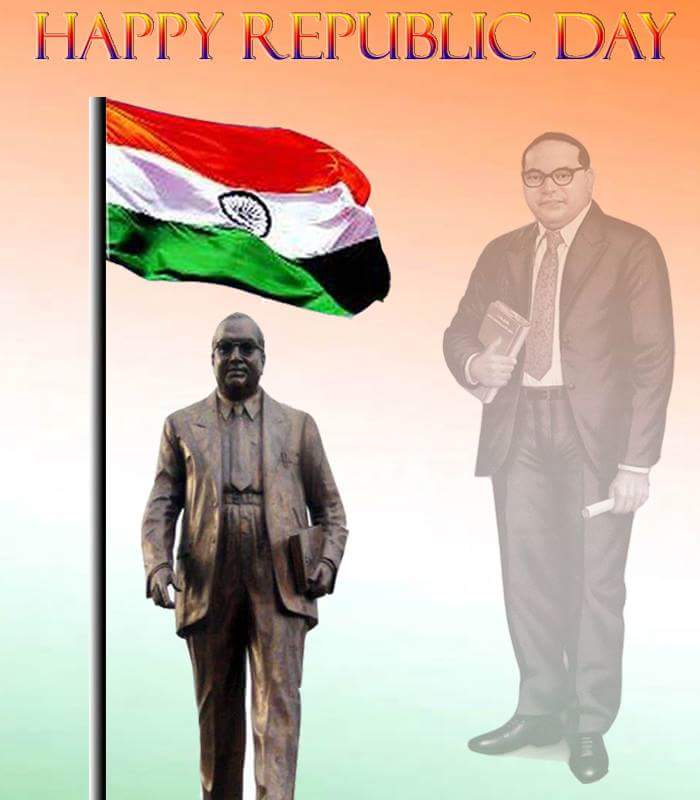
26 facts you need to know about 26th January – Indian Republic Day


  1. On 29 August, 1947, the constituent assembly set up a drafting committee under the Chairmanship of Dr. B.R. Ambedkar to prepare a draft constitution for India. While deliberating upon the draft constitution, the assembly moved, discussed and disposed of as many as 2,473 amendments out of a total of 7,635 tabled.
  2. The assembly met in sessions open to the public, for 166 days, spread over a period of 2 years, 11 months and 18 days before adopting the Constitution, the 308 members of the Assembly signed two copies of the document (one each in Hindi and English) on 24 January 1950.
  3. Dr. Ambedkar was one of the very few Indian statesmen-politicians who actively participated in the discussions on Constitutional matters from the Monsford Reforms (1919) to the Cabinet Mission (1946) proposals.
  4. 26th January is the real independence day of Dalits because on this day Manusmriti/Vedic laws came to end.
  5. Dalit-Bahujans got human rights on this day. It is the real Independence Day for Dalits, otherwise on 15th August there was just a power transfer from British to so called upper caste people of India.
  6. Indian constitution is the longest written constitution of any sovereign country in the world, containing 448 articles in 25 parts, 12 schedules, 5 appendices and 98 amendments.
  7. At the time of commencement, the constitution had 395 articles in 22 parts and 8 schedules.
  8. As of December 2014, 98 amendments have been made to the Constitution of India since it was first enacted in 1950.
  9. It consists of almost 80,000 words and took 2 years 11 months and 18 days to build. Main work was done by Dr. B. R. Ambedkar only.
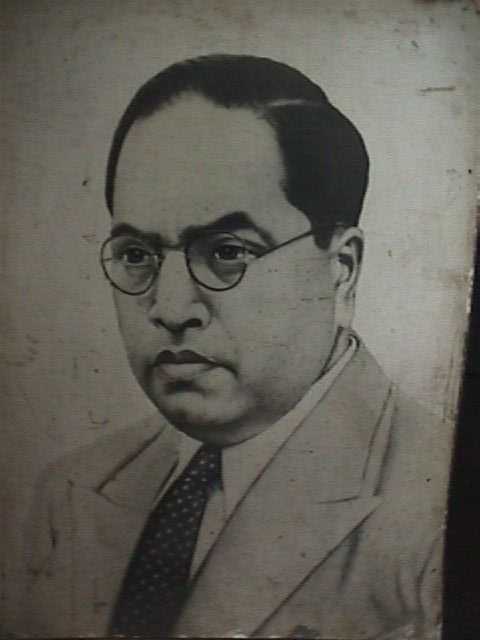
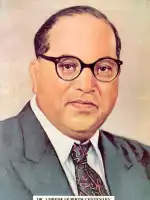
  10. Dr. B R Ambedkar is regarded as the architect of the Indian Constitution. Dr. B R. Ambedkar was an untouchable, who was denied access to education but he struggled and educated himself and became the first law minister of India.
  11. The Constitution came into a legal circulation at 10:18am IST on the 26th of January, 1950.
  12. There are just two original copies of the Constitution in the country written in Hindi and English.
  13. Indian constitution was all hand-written and it was on the 26th of January that marked the celebration of Independence in its true sense.
  14. The Indian emblem is adapted from the Ashoka Pillar at Sarnath, dating back to 250 BC.
  15. The original book of our Constitution is a 479 page calligraphic edition signed by all our framers and
  16. The original book of our Constitution is preserved in a helium filled case in the Library of Parliament.
  17. Parliamentary system was borrowed from Buddhism. IMG_9811118112632
  18. Dr. Ambedkar said on constitution that ‘I feel that the constitution is workable, it is flexible and it is strong enough to hold the country together both in peacetime and in wartime. Indeed, if I may say so, if things go wrong under the new Constitution, the reason will not be that we had a bad Constitution. What we will have to say is that Man was vile.’
  19. Granville Austin described the Indian Constitution drafted by Dr. Ambedkar as ‘first and foremost a social document’. … ‘The majority of India’s constitutional provisions are either directly arrived at furthering the aim of social revolution or attempt to foster this revolution by establishing conditions necessary for its achievement.
  20. In India, Republic Day means the day honours the date on which the Constitution of India came into force on 26 January 1950 replacing the Government of India Act (1935), Dr B R Ambedkar was the Drafting committee chairmen of constitution of India. Therefore, this day is remember the contributions of Dr B. R. Ambedkar.
  21. The date 26 January, as everyone knows, was when the Constitution of India came into force. This date was, later on, chosen to honour the memory of the “Declaration of Independence of 1930” from the British Rule.
  22. Dr Ambedkar – On 26th January 1950, we are going to enter into a life of contradictions. In politics, we will have equality and in social and economic structure, continue to deny the principle of one man one value. How long shall we continue to live this life of contradictions? How long shall we continue to deny equality in our social and economic life? If we continue to deny it for long, we will do so only by putting our political democracy in peril. We must remove this contradiction at the earliest possible moment else those who suffer from inequality will blow up the structure of democracy which this Constituent Assembly has so laboriously built up.
  23. Dr Ambedkar was criticized for giving more powers to centre government. In the draft Constitution Dr. Ambedkar offered more powers to the Centre and made it strong. Some members of the constituent assembly criticised him on the ground that since Dr. Ambedkar postulated – the rights and values of each individual and the development of each province and each–village, it was contradictory of his part to make the Centre strong.
  24. Justifying the provisions for a strong Central authority Dr. Ambedkar said that he made the centre strong not only to ‘save minorities from the misrule of majority’ but also “for it is only the centre which can work for a common end and for the general interests of the country as a whole.”
  25. On the night of January 25, 1999 – on the eve of Republic Day – around 100 armed Ranvir Sena activists raided a Dalit hamlet at Shankar Bigha village in central Bihar’s Jehanabad district and gunned down at least 23 villagers in cold blood while they were asleep in their mud-built houses and huts. The marauders had also set afire their houses before fleeing the scene. Of the dead, five were women and seven children — the youngest being six months old.
  26. These are the opening words of the preamble to the Indian Constitution
WE, THE PEOPLE OF INDIA, having solemnly resolved to constitute India into a SOVEREIGN SOCIALIST SECULAR DEMOCRATIC REPUBLIC and to secure to all its citizens:

JUSTICE, social, economic and political;

LIBERTY of thought, expression, belief, faith and worship;

EQUALITY of status and of opportunity;

and to promote among them all

FRATERNITY assuring the dignity of the individual and the unity and integrity of the Nation;

IN OUR CONSTITUENT ASSEMBLY this twenty-sixth day of November, 1949, do HEREBY ADOPT, ENACT AND GIVE TO OURSELVES THIS CONSTITUTION.

Related articles –

4 Comments

Filed under Dalit-Bahujans, Dr B R Ambedkar, Equal Rights, India, Today in Dalit History, Today in History

Teesri Azadi – Full Movie


“There is a no nation of Indians in the real sense of the world; it is yet to be created. How can people divided into thousands of castes be a nation?” — Dr B R Ambedkar

480

Watch truth about Indian History.

Related articles:

1 Comment

Filed under Caste Discrimination, Casteism, Dalit-Bahujans, Documentary, Movie

16 January in Dalit History – Dr. Ambedkar: I am not asking for any special favour

16 January 1930: Periyar returned from Malaya to Tamil Nadu.

16 January 1931: Dr. Ambedkar commented on the Report of sub- committee no VII (defense) at the round table conference in London.

Dr. Ambedkar vehemtly fought for the rights of inclusion of all sections, including the depressed classed (presently called dalits) for recruitment in Indian Army and hence sought a substantiative amendment to clause (2) of paragraph 4 of the report. “No doubt”, he said, “I move the amendment primarily with a view to protecting the specific rights of the depressed classes, but in doing so I am not asking the Committee to confer any favour, I am asking the Committee to see us realize in practice the principle recognized in the Government of India Act, that no subject of His Majesty shall be debarred from entering any Public Service by reason of his caste, creed or colour. In doing so, therefore, I do not think I am asking for any special favour”.

For details do visit

http://www.ambedkar.org/ambcd/15B.%20Dr.%20Ambedkar%20at%20the%20Round%20Table%20Conferences.htm#a2

135265_449711565104957_150069038_o

16 January 1946: Riots between touchables and untouchables erupted (Hindu – Mahar riots).

Dr. Ambedkar believed that a candidate to be elected on reserved seat should be elected only on the votes of untouchables (separate electorates). However, as a consequce of Poona Pact (signed in 1932), the Congress party would field a candidate from any other untouchable against Dr. Ambedkar and they would have no problems with his candidature even if he was illereate or an absolute non-entity.  They would ask all (touchables) to give votes to their untouchable candidate. This was Kautilya – style strategy only to defeat Dr. Ambedkar! It was because of this that the deadly riots of Hindu vs Mahar erupted on 16 January 1946 in Nagpur against the Poona Pact.

The dalit movement in Nagpur came to be known as Mahar movement. Chambhars (leather workers) and Mangs (rope makers, also called Matangs) took part only as individuals. E.g. A gentleman named Behade was on the executive committee of the Scheduled Caste Federdarion. Ramratan Janorkar of Bhangi (sweeper) community dedicated his life to the Ambedkar movement and also became a Buddhist and later on Mayor of the Nagpur Municipal Corporation.

Continue reading

Leave a comment

Filed under Buddhism, Caste Discrimination, Dalit-Bahujans, Dr B R Ambedkar, Today in Dalit History, Today in History

15th January in Dalit History – B’day of Behan Mayawati


Behan Mayawati, a four-time Chief Minister of Uttar Pradesh, is chief of Bahujan Samaj Party which is, at present, main opposition party in the Assembly of Uttar Pradesh. Watch documentary and interview with Behan Mayawati

Also see rare pictures of Kanshi Ram Saheb and Mayawati.

Continue reading

4 Comments

Filed under BSP, Buddhism, Dalit-Bahujans, Documentary, Today in Dalit History, Today in History

15th January in Dalit History – Death anniversary of Namdeo Dhasal, a founder of the Dalit Panthers


Namdeo Dhasal, a founder of the Dalit Panthers and a revolutionary poet, died on January 15, 2014..   He will be missed by all those dedicated to the revolutionary anti-caste movement.  For a time the Dalit Panthers symbolized the rebellious aspirations of a generation of Dalit youth.  Dhasal’s poetry was militant and hardhitting; Golpitha, his first collection, was named after a red-light district in Mumbai.  Golpitha’s language reflected the raw realism of that milieu.  “Poetry is politics,” said Dhasal, and he acted accordingly,

Namdeo Dhasal

Namdeo Dhasal

Political splits occurred in the Panther movement, but the spirit continued.  His poem “Kamatipura” (from Golpitha) is given below:

KAMATIPURA

The nocturnal porcupine reclines here
Like an alluring grey bouquet
Wearing the syphilitic sores of centuries
Pushing the calendar away
Forever lost in its own dreams

Man’s lost his speech
His god’s a shitting skeleton
Will this void ever find a voice, become a voice?

If you wish, keep an iron eye on it to watch
If there’s a tear in it, freeze it and save it too
Just looking at its alluring form, one goes berserk
The porcupine wakes up with a start
Attacks you with its sharp aroused bristles
Wounds you all over, through and through
As the night gets ready for its bridegroom, wounds begin to blossom
Unending oceans of flowers roll out
Peacocks continually dance and mate

This is hell
This is a swirling vortex
This is an ugly agony
This is pain wearing a dancer’s anklets

Shed your skin, shed your skin from its very roots
Skin yourself
Let these poisoned everlasting wombs become disembodied.
Let not this numbed ball of flesh sprout limbs
Taste this
Potassium cyanide!
As you die at the infinitesimal fraction of a second,
Write down the small ‘s’ that’s being forever lowered.

Here queue up they who want to taste
Poison’s sweet or salt flavour
Death gathers here, as do words,
In just a minute, it will start pouring here.

O Kamatipura,
Tucking all seasons under your armpit
You squat in the mud here
I go beyond all the pleasures and pains of whoring and wait
For your lotus to bloom.
— A lotus in the mud.

This raw “poetry of the underworld” is the heritage of Namdeo Dhasal.

By – Gail Omvedt and originally posted at here.

1 Comment

Filed under Dalit-Bahujans, Dr B R Ambedkar, Today in Dalit History, Today in History

14th January in Dalit History – Namantar Din


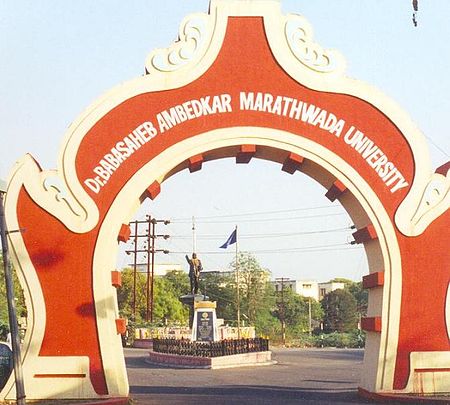
14th January,1994 : Dr. Baba Saheb Ambedkar Marathwada University’s Namantar Din. Movement which led to change the name was called “Namantar movement”, started around 1978 by Dalit Panther leaders. There has been a long struggle for changing the name of Marathwada university to Ambedkar’s name.

Large number of dalits suffered in this, many Dalit women were tortured by so called upper caste people (Shiv Sena, RSS people), those were opposing this renaming of University.

Gate of the renamed university and statue of Dr. Ambedkar in distance

Gate of the renamed university and statue of Dr. Ambedkar in distance

There were many songs of struggle, such as..

Marathwada is Burning 

One Pochiram Kamble, sweating to fill his stomach,

He became the enemy of the village,

“Jay Bhim” was on his lips…

Accosted in the fields, bound with a rope,

His hands and feet branded, then thrown in the fire,

He burned fiercely, the son of Bhim…

We see all this with open eyes,

Still we live our lives,

By our own hands feeding,

The fire that burns the corpse,

We the people of Bombay and Pune —

How hollow is our pose!

We gossip about revolution

But lead the lives of eunuchs,

Oh, kill, smash, cut, break,

Whatever comes in our way!

Marathwada is Burning, Marathwada is Burning …

— By Vikas Ghogare (from Reinventing Revolution by Gail Omvedt)

At present with this university, there are more than 160 colleges affiliated and more than 25 courses are taught.

Photo credit – Wikipedia

3 Comments

Filed under Caste Discrimination, Dalit-Bahujans, Dr B R Ambedkar, Today in Dalit History, Today in History

Dr. Babasaheb Ambedkar Movie in Tamil


Watch movie in Hindi and English from here.

3 Comments

Filed under BSP, Caste Discrimination, Dalit-Bahujans, Documentary, Dr B R Ambedkar, Movie

Upcoming movie – 500 : A Battle of Koregaon


An Untold History, A Battle of Self-Respect, Dignity and Co-Existence. A Saga of a Subjugated Society which tells a true story of Bravery & Fortitude & how 28000 soldiers were killed by 500.

Also read about 1st January,1818: The Battle of Bhima Koregaon and watch Documentary on Bhima Koregaon

8 Comments

Filed under Caste Discrimination, Casteism, Dalit-Bahujans, Documentary, Equal Rights, Movie