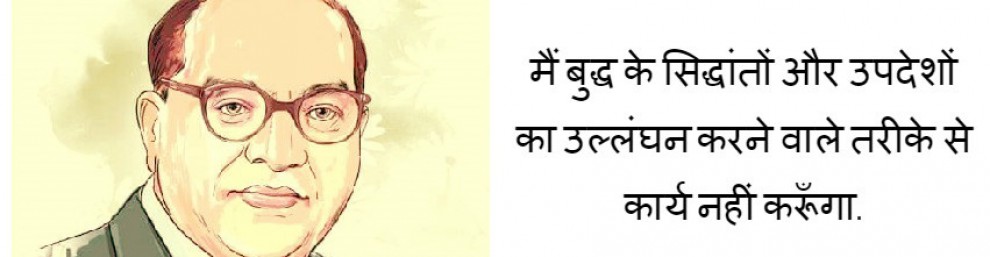
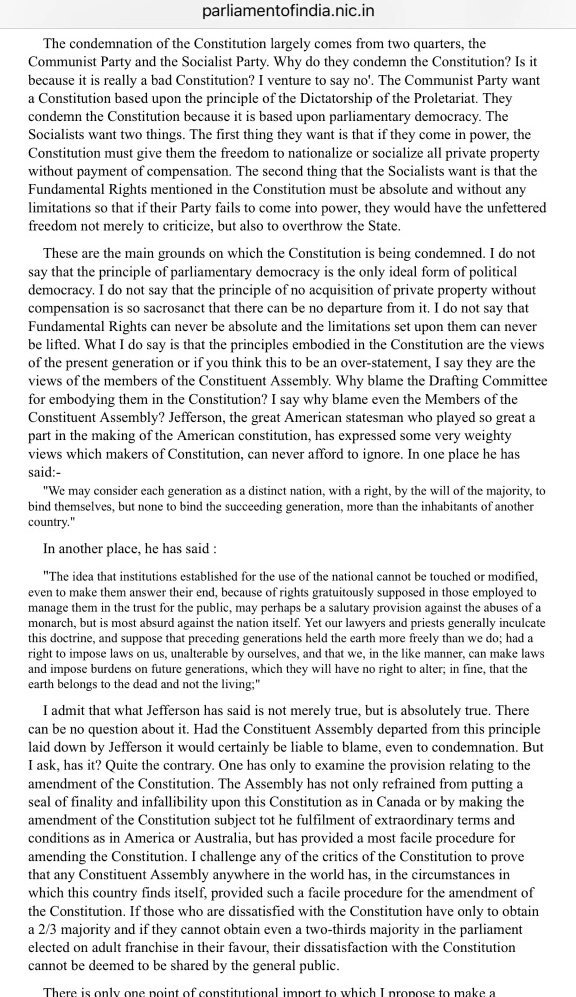
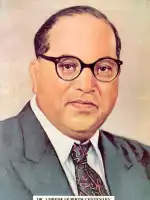
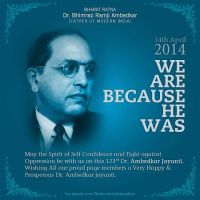
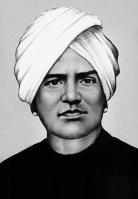
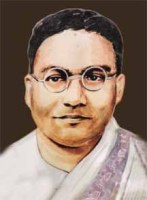
The condemnation of the Constitution largely comes from two quarters, the Communist Party and the Socialist Party. Why do they condemn the Constitution? Is it because it is really a bad Constitution? I venture to say no’. The Communist Party want a Constitution based upon the principle of the Dictatorship of the Proletariat. They condemn the Constitution because it is based upon parliamentary democracy. The Socialists want two things. The first thing they want is that if they come in power, the Constitution must give them the freedom to nationalize or socialize all private property without payment of compensation. The second thing that the Socialists want is that the Fundamental Rights mentioned in the Constitution must be absolute and without any limitations so that if their Party fails to come into power, they would have the unfettered freedom not merely to criticize, but also to overthrow the State. – Dr.B. R. Ambedkar
Tag Archives: dalits
What Dr Ambedkar said about Communists & Socialists criticizing the Constitution of India
Filed under Caste Discrimination, Casteism, Constitution of India, Dalit, Dr B R Ambedkar
Comrades, shall we start the revolution?
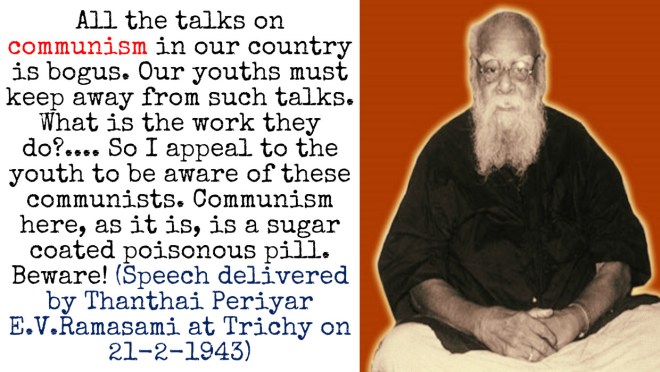
Communism, as it is, is a sugar coated poisonous pill. Beware! – E. V. R. Periyar
The leader of the Congress party is a Brahmin. The leader of the socialists is a Brahmin. The leader of the communists is a Brahmin. The leader of the Hindu Maha Sabha is a Brahmin. The leader of R.S.S is a Brahmin. The leader of the Trade Union is a Brahmin. The President of India is a Brahmin. They are all one in the heart of hearts.
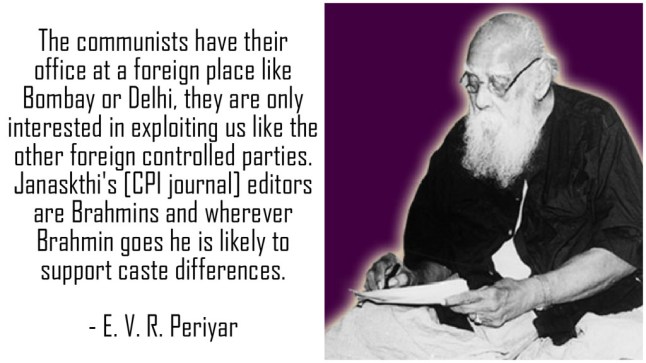
The communists have their office at a foreign place like Bombay or Delhi, they are only interested in exploiting us like the other foreign controlled parties. Janaskthi’s [CPI journal] editors are Brahmins and wherever Brahmin goes he is likely to support caste differences.
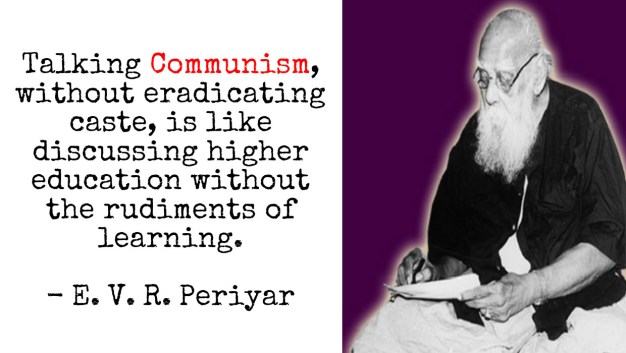
Talking Communism, without eradicating caste, is like discussing higher education without the rudiments of learning.
There can be no scope for communism in a country, where there is absence of common ownership and rights. If attempts are made to bring in communism in a country, which does not have common ownership and rights, it will only give room for those who already enjoy more rights to reap the benefits of communism.
One day or other the co-operative spirit will reign supreme making the society march on towards progress. It is not necessary that communism should be fostered for that. Without talking a word about communism, you can make the society progressive with the help of mere co-operation.
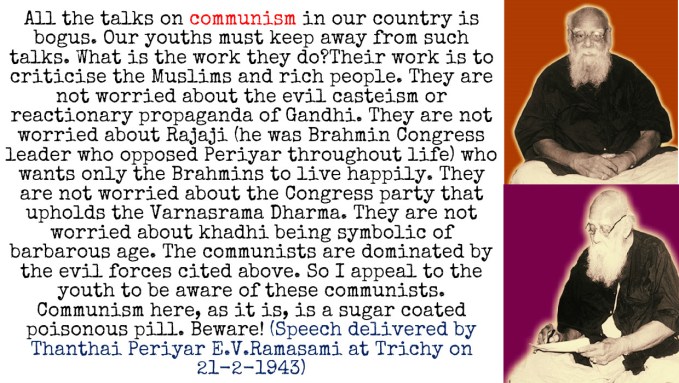
All the talks on communism in our country is bogus. Our youths must keep away from such talks. What is the work they do? Their eyes are always on the leaders of the Justice Party (In 1944, Periyar transformed the Justice Party into the social organisation Dravidar Kazhagam and withdrew it from electoral politics). Their work is to criticise the Muslims and rich people. They are not worried about the evil casteism or reactionary propaganda of Gandhi. They are not worried about Rajaji (he was Brahmin Congress leader who opposed Periyar throughout life) who wants only the Brahmins to live happily. They are not worried about the Congress party that upholds the Varnasrama Dharma. They are not worried about khadhi being symbolic of barbarous age. The communists are dominated by the evil forces cited above. So I appeal to the youth to be aware of these communists. Communism here, as it is, is a sugar coated poisonous pill. Beware! (Speech delivered by Thanthai Periyar E. V. Ramasami at Trichy on 21-2-1943)
Source – Veeramani, DR. K. (2014-01-30), COLLECTED WORKS OF PERIYAR E.V.R.
Filed under Caste Discrimination, Casteism, Dalit, Dr B R Ambedkar, Periyar
[Video] Dr. Ambedkar launches Kalaram Temple Satyagraha
[Video] Dr. Ambedkar launches Kalaram Temple Satyagraha, a part from Dr. Ambedkar movie.
#Budget2016 once again fails to deliver for the Dalit Adivasis
On February 29, Union Finance Minister delivered the second full budget of the BJP-NDA government. Though we applaud the allocation of Rs. 500 crores under the stand-up India scheme for SC/ST entrepreneurs, the overall allocation under SCSP TSP is extremely poor.
The allocations for SC under the Union Budget 2016 is only 7.6% when the due amount under SCSP budget should be 16.8% which should amount to Rs.91,301 and 8.6% under TSP which should amount to Rs.47,300 Crs. Thus denying a total of Rs 75,764 crore. NCDHR condemns this denial in allocation.
The budget comes at a crucial point with UGC withdrawing non-NET fellowships and death of Rohith Vemula a PhD student at Hyderabad University. The underlying issue of both these instances has been denial of mandatory funds to research scholars. Paul Divakar, General Secretary, National Campaign on Dalit Human Rights, holds the finance minister accountable when and questions, “Where is the missing Rs. 75,773 Crs? Yet another massive denial & disinterest to bridge the growing development gap.”
Dr. B.R. Ambedkar reasoned that higher education was an important instrument, to seek power and dignity for all. Hence advocated for public education being critical for the empowerment of Dalit and backward classes. Access and opening of educational institutions by the historically excluded groups has been a moment of rupture in history and met with violent backlash from the dominant community.
The events of the previous months— cutting of non-NET fellowships, denial of fellowship money to PhD students in Hyderabad and other universities— point at this violent backlash from the dominant community. The Union Budget 2016-17 is another example of this violent backlash. The denial in money allocated for the purpose of higher education to be accessed by the community further makes their struggle for equality a tougher one. Additionally, it acts as violation of constitutionally mandated rights of the SC/ST community.
Of the total of Rs 897 crore allocated under UGC. 60% goes towards capital assets and another 30% towards grants-in-aid and only 8% directly benefiting SC and ST students.
SECTOR-WISE
If we analyse the allocation sector wise, over 86% of the Dalit budget is spent on Social Service, Welfare and Housing Sectors. They do not form the triggers for development except for Higher education. Without greater allocations for Agriculture and allied, rural development Schemes, Energy, industry and mineral, Science and technology and communication, the overall growth of the SC and ST will be very lopsided. Innovation is needed to design schemes for the Dalit & Adivasi men and women in these sectors.
Dalit Adivasi women continue to be at the margins
The budget continues to marginalise Dalit-Adivasi women by allocating a measly 1% to Dalit women and 2% to Adivasi women without taking into account the needs, and voices of women. The schemes lack an understanding of their lived reality and is blind to the concerns of the Dalit and Adivasi women.
Filed under Caste Discrimination, Casteism, Dalit, Dr B R Ambedkar, Equal Rights, Protest
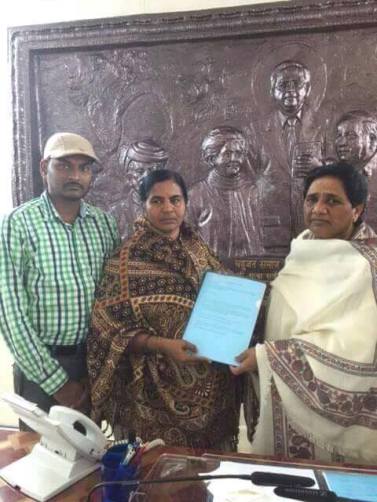
दलित छात्र रोहित की माँ से मिली मायावती जी
मायावती ने परिवार के लोगों को सांत्वना देते हुये कहा कि रोहित वेमुला को आत्महत्या ने देश के लोगों को बेचैन कर दिया है।
लखनऊ : बहुजन समाज पार्टी की राष्ट्रीय अध्यक्ष, सांसद (राज्यसभा) व पूर्व मुख्यमंत्री, उत्तर प्रदेश मायावती ने आज यहाँ अपने नई दिल्ली निवास पर हैदराबाद सेन्ट्रल यूनिवर्सिटी में पी.एच.डी. के दलित छात्र रहे रोहित वेमुला के शोक-संतृप्त परिवार से मुलाकात की और उनकी दुःख भरी आपबीती सुनी।
रोहित वेमुला की माँ और भाई ने मायावती से अपनी मुलाकात के दौरान विस्तार से बताया कि किस प्रकार से केन्द्र के दो मंत्रियों के दबाव में श्री वेमुला को प्रताड़ित किया जाता रहा, जिस कारण अन्ततः उसे आत्महत्या के लिये मजबूर होना पड़ा।
उन्होंने बताया कि इस दर्दनाक घटना के सम्बन्ध में संसद के दोनों सदनों में सरकार ख़ासकर मानव संसाधन मन्त्री स्मृति ईरानी की ओर से कितनी ज्यादा ग़लतबयानी करके देश की जनता को गुमराह किया जा रहा है। इस कारण उन्हें नहीं लगता है कि केन्द्र की भाजपा सरकार उनके बेटे को उसकी मौत के बाद भी इन्साफ दिला पायेगी।
रोहित वेमुला के परिवार वालों ने बी.एस.पी. प्रमुख का शुक्रिया अदा किया कि उन्होंने अन्य बातों के साथ-साथ न्यायिक जाँच आयोग में दलित समाज के व्यक्ति को रखने की ज़ोरदार मांग सदन में और सदन के बाहर भी की, परन्तु केन्द्र सरकार ने इसे मानने से इन्कार कर दिया, जिससे उसकी नीयत में खोट साफ तौर पर लगता है। श्री वेमुला पर इतनी ज्यादा जुल्म-ज्यादती करने के बाद अब उसकी जाँच निष्पक्ष हो यह भी केन्द्र सरकार को मंजूर नहीं है। इससे इनकी दलित-विरोधी मानसिकता का भी पर्दाफाश होता है।
मायावती ने परिवार के लोगों को सांत्वना देते हुये कहा कि रोहित वेमुला को आत्महत्या हेतु मजबूर करने के अत्यन्त ही दुःखद मामले ने देश के लोगों को बेचैन कर दिया है और दलितों के साथ-साथ वे लोग भी रोहित वेमुला को न्याय दिलाने के लिये उस घटना के दोषी लोगों को सजा दिलाने के लिये लगातार ही संघर्षरत हैं।
Sati Was Started For Preserving Caste
Dr. K. Jamanadas
With the much discussed subject, now in India, about a so called “sati” of Charanshah, in village Satpura in Uttar Pradesh, some information about this evil in Hindu social system, may be not only informative but also educative to the masses who wish to build a new India on new values.
Condition of Widows in ancient India
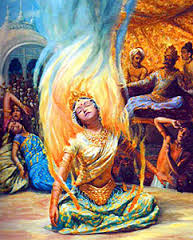
In India, the condition of women in general, was made more dreadful than that of a slave, but the lot of widows was always very hard and they were forced to lead a horrible life of torture, disfigurement, tonsure and deprivation, with an enforced strict ban on remarriage. They were compelled to undergo sex with other men for procreation under the system of Niyoga. As if this was not enough, a peculiar system existed in India, whereby widows were burnt alive on the funeral pyre of their dead husbands. The practice existed among the higher castes mainly, though it was given a honorable and prestigious outlook among the masses by various means adopted by the Brahmins.
Why this system started in India? It was for maintaining the caste, which was very important for the welfare of those, who are benefited by it. And as the caste system grew more rigid, the sati become more strict. Notable example is Bengal, where it was enforced more strictly because of “Kulin system”, where any of the hundreds of disgruntled young wives could easily poison the old man.
Position of women
Ms. Shakuntala Rao Shastri, in her “Women in Sacred Laws” very aptly describes the pitiable condition of women before the Britishers came to India:
“True it is that anyone who has witnessed the pathetic condition of women in India at the dawn of British rule cannot but be shocked at it: the enforced child marriage, the exposure of female children, putting to death female children by throwing them at the junction of the Ganges and the sea, the violence used to make women follow the Sati rite and thus end their miserable existence, the shameful treatment accorded to a widow, the (in)famous kulinism which made marriage a profession rather than a sacrament, made woman not only an object of pity but many a woman sighed in the secret recess for her heart and wished that she had never been born a woman in this unfortunate country.” [Shastri Shakuntala Rao, “Women in Sacred Laws” p. 171]
The situation described by the learned Vedic Scholar is at the time of dawn of British occupation, but since how long it was in existence? The reply is that this was the situation since the fall of Buddhism around tenth century A.D. That the women enjoyed high position in Buddhist period can be judged by a mere glance at the Buddhist law being practiced in India before tenth century A.D. and which is practiced in all the Buddhist countries even now.
Filed under Caste Discrimination, Casteism, Dalit, Dalit History, Dr B R Ambedkar, Equal Rights
Constitutional Safeguards for Dalits
SAFEGUARDS IN THE INDIAN CONSTITUTION FOR SCHEDULED CASTES
AND SCHEDULED TRIBES
The important Constitutional safeguards for SCs & STs are mentioned below:
(a) Directive Principles of State Policy
Article 46 is a comprehensive article comprising both the developmental and regulatory aspects. It reads as follows:
“The State shall promote with special care the educational and economic interests of the weaker sections, of the people, and in particular, of the Scheduled Castes and the Scheduled Tribes, and shall protect them from social injustice and all forms of exploitation”.
(b) Social Safeguards
Article 17. “Untouchability” is abolished and its practice in any form is forbidden. The enforcement of any disability arising out of “Untouchability” shall be an offence punishable in accordance with law.
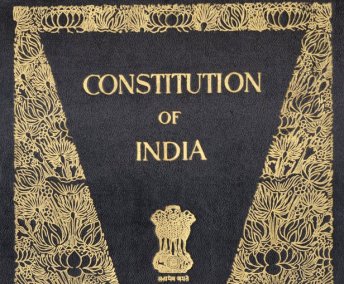
To give effect to this Article, Parliament made an enactment viz., Untouchability (Offences) Act, 1955. To make the provisions of this Act more stringent, the Act was amended in 1976 and was also renamed as the Protection of Civil Rights Act, 1955. As provided under the Act, Government of India also notified the Rules, viz., the PCR Rules, 1977, to carry out the provisions of this Act. As cases of atrocities on SCs/STs were not covered under the provisions of PCR Act, 1955, Parliament passed another important Act in 1989 for taking measures to prevent the atrocities. This act known as the Scheduled Castes and the Scheduled Tribes (Prevention of Atrocities) Act, 1989, became effective from 30.1.1990. For carrying out the provisions of this Act the Govt. of India have notified the SCs and the STs (Prevention of Atrocities) Rules, 1995 on 31.3.1995.
Article 23. Prohibits traffic in human beings and begar and other similar forms of forced labour and provides that any contravention of this provision shall be an offence punishable in accordance with law. It does not specifically mention SCs & STs but since the majority of bonded labour belong to SCs/STs this Article has a special significance for SCs and STs. In pursuance of this article, Parliament has enacted the Bonded Labour System (Abolition) Act, 1976. For effective implementation of this Act, the Ministry of Labour is running a Centrally Sponsored Scheme for identification, liberation and rehabilitation of bonded labour.
Article 24 provides that no child below the age of 14 years shall be employed to work in any factory or mine or engaged in any other hazardous employment. There are Central and State laws to prevent child labour. This article too is significant for SCs and STs as a substantial portion, if not the majority, of child labour engaged in hazardous employment belong to SCs and STs.
Article 25(2)(b) provides that Hindu religious institutions of a public character shall be thrown open to all classes and sections of Hindus. This provision is relevant as some sects of Hindus used to claim that only members of the concerned sects had a right to enter their temples. This was only a subterfuge to prevent entry of SC persons in such temples. For the purpose of this provision the term Hindu includes Sikh, Jaina and Budhist.
Educational and Cultural Safeguards
Article 15(4) empowers the State to make any special provision for the advancement of any socially and educationally backward classes of citizens or for SC and ST. This provision has enabled the State to reserve seats for SCs and STs in educational institutions including technical, engineering and medical colleges and in Scientific & Specialised Courses. In this as well as in Article 16(4)the term ‘backward classes’ is used as a generic term and comprises various categories of backward classes, viz., Scheduled Castes, Scheduled Tribes, Other Backward Classes, Denotified Communities (Vimukta Jatiyan) and Nomadic/Seminomadic communities.
Filed under Caste Discrimination, Casteism, Dalit, Dalit-Bahujans, Dr B R Ambedkar, Equal Rights