Tag Archives: Caste Discrimination

Casteism in Examination Halls!


This is a question from Higher Secondary Hindi exam paper which was held on March 5, 2016 in Madhya Pradesh. One of the choices offered for writing a 200 word essay is, ‘Why Caste-based reservations are harmful to the nation’.

We strongly condemn this attempt by the state Govt to brainwash students against the constitutional provision of affirmative action.

Will MP government ask questions such as why there was 100% reservation for Brahmins in Temples? Or 100% reservation for Brahmins in Temples is harmful for the nation? Or why paid seats quota is harmful for the nation?

Caste in Examination Halls

1 Comment

Filed under Caste Discrimination, Casteism, Dalit, Dr B R Ambedkar

#Budget2016 once again fails to deliver for the Dalit Adivasis


On February 29, Union Finance Minister delivered the second full budget of the BJP-NDA government. Though we applaud the allocation of Rs. 500 crores under the stand-up India scheme for SC/ST entrepreneurs, the overall allocation under SCSP TSP is extremely poor.

The allocations for SC under the Union Budget 2016 is only 7.6% when the due amount under SCSP budget should be 16.8% which should amount to Rs.91,301 and 8.6% under TSP which should amount to Rs.47,300 Crs. Thus denying a total of Rs 75,764 crore. NCDHR condemns this denial in allocation.

226018_158150314334299_241024368_nThe budget comes at a crucial point with UGC withdrawing non-NET fellowships and death of Rohith Vemula a PhD student at Hyderabad University. The underlying issue of both these instances has been denial of mandatory funds to research scholars. Paul Divakar, General Secretary, National Campaign on Dalit Human Rights, holds the finance minister accountable when and questions, “Where is the missing Rs. 75,773 Crs? Yet another massive denial & disinterest to bridge the growing development gap.”

Dr. B.R. Ambedkar reasoned that higher education was an important instrument, to seek power and dignity for all. Hence advocated for public education being critical for the empowerment of Dalit and backward classes. Access and opening of educational institutions by the historically excluded groups has been a moment of rupture in history and met with violent backlash from the dominant community.

The events of the previous months— cutting of non-NET fellowships, denial of fellowship money to PhD students in Hyderabad and other universities— point at this violent backlash from the dominant community. The Union Budget 2016-17 is another example of this violent backlash. The denial in money allocated for the purpose of higher education to be accessed by the community further makes their struggle for equality a tougher one. Additionally, it acts as violation of constitutionally mandated rights of the SC/ST community.

Of the total of Rs 897 crore allocated under UGC. 60% goes towards capital assets and another 30% towards grants-in-aid and only 8% directly benefiting SC and ST students.

SECTOR-WISE          

If we analyse the allocation sector wise, over 86% of the Dalit budget is spent on Social Service, Welfare and Housing Sectors. They do not form the triggers for development except for Higher education. Without greater allocations for Agriculture and allied, rural development Schemes, Energy, industry and mineral, Science and technology and communication, the overall growth of the SC and ST will be very lopsided. Innovation is needed to design schemes for the Dalit & Adivasi men and women in these sectors.

Dalit Adivasi women continue to be at the margins

The budget continues to marginalise Dalit-Adivasi women by allocating a measly 1% to Dalit women and 2% to Adivasi women without taking into account the needs, and voices of women. The schemes lack an understanding of their lived reality and is blind to the concerns of the Dalit and Adivasi women.

Leave a comment

Filed under Caste Discrimination, Casteism, Dalit, Dr B R Ambedkar, Equal Rights, Protest

Caste and Hinduism – By Gail Omvedt


M V Nadkarni’s recent article “Is Caste System Intrinsic to Hinduism?: Demolishing a Myth”, (EPW, November 8, 2003) comes as a follow-up to his earlier article “Ethics and Relevance of Conversions: A Critical Assessment of Religious and Social Dimensions in a Gandhian Perspective”(Januay 18). Both articles show the fundamental stamp of Hindutva ideology, primary of which is shoddy methodology, selective quotation (for example, his references to my work are to a 10-year old book and selectively at that), and illogic.

caste-step-ladder

The illogic in the ‘Caste System’ article begins with a basic, unexamined premise: that there is some entity called ‘Hinduism’, a religion which has lasted 4,000 years and which comprehends ‘classical’ as well as ‘medieval’ and ‘modern’ forms. This is the most historically unjustified premise, since the term ‘Hindu’ to refer to a religious belief was never used until the establishment of Muslim regimes (and then only in some parts of India; for instance, Tukaram – who Nadkarni takes as one of the ‘Hindu’ bhakti
sants, never in all his 4,700 abhangs used this word) and it never came into generalised use throughout India until the 19th century. This has been documented by numerous scholars and I will not cite them here. The illogic is that Nadkarni assumes, and documents, changes in the caste as a socio-historical structure (which I think is correct) but does not question the supposedly unchanging character of an essential ‘Hinduism’. (Incidentally, Nadkarni is silent on whether Buddhism, Jainism and the shramanic traditions should be considered as part of ‘Hinduism’).

Other mistakes pale before this basic point, but I will take up a few issues.

Continue reading

Leave a comment

Filed under Caste Discrimination, Casteism, Dalit, Dr B R Ambedkar, Equal Rights

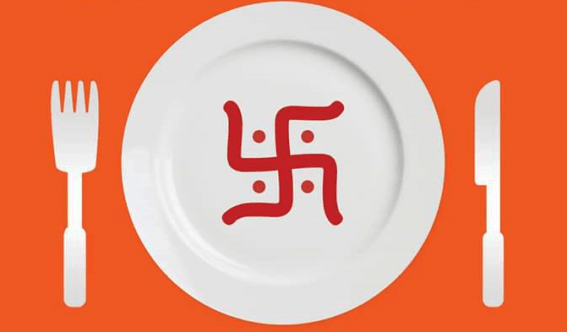
Brahmins bringing caste to your food plate


I wrote few days back about what is the caste of your food? It’s no strange for me that Brahminism has infiltrated to such an extent that caste has reached your food table and or to your plate.

4

A friend sent me these following website especially promoting Brahmin food and Brahminism through food, as my friend puts these in words.

Now you can Buy Brahmins online!

These websites are running and society has no problem, will society accept and buy if such foods are launched by lower castes? All these Brahmin sites who show caste pride should be shut down.

1

Another friend of mine described these products as –

Totally puke-worthy.

2

3

Leave a comment

Filed under Caste Discrimination, Casteism, Dalit, Dr B R Ambedkar, Equal Rights, India

Research Shows Caste Discrimination in Indian Private Sector


Discrimination on the basis of caste endures in the formal labor market of contemporary India, according to Paul Attewell of the City University of New York Graduate Center and Katherine S. Newman of the Johns Hopkins University Department of Sociology.

Check also – Caste Discrimination in Jobs at Private Sector. What is the caste of your company?

Speaking at the Institute this month, Attewell and Newman outlined three of four discrimination studies collaboratively undertaken by Princeton University and the Indian Institute of Dalit Studies: a field experiment based in employer-employee correspondence, a study focusing on employer attitudes toward caste, and a prospective cohort study of lower-caste university graduates in elite institutions.

Read also – Caste Discrimination in Public Distribution System (PDS)

The origin of the overarching project, Attewell said, lies in the recent debate in Indian English-language press over extending the reservation system currently operating in India into the country’s private sector. The Indian reservation system allots a percentage of public sector jobs and places in higher educational institutions to minority applicants, including those of religious minorities and Dalits, a group traditionally regarded to be of low caste. Representatives of the private sector expressed overwhelming opposition to the possibility of extending reservation, citing an ostensible lack of evidence of discrimination against Dalits in the modern private sector, Attewell said.

Check also – Caste Discrimination at UGC

In order to correct the “dearth of research [speaking] to these issues,” the project employed a series of empirical techniques developed by social scientists in the US to investigate “enduring discrimination against African Americans,” Attewell said. The studies aimed to determine whether modern inequalities are “based on caste or community leftovers from the past,” whether these inequalities are “reflections of low education or working in an economically ‘backward’ sector,” and whether discrimination continues to take place “even in the most modern, dynamic sectors of the Indian economy.”

Read also – What is the caste of your food?

pablo (1)

The field experiment focused on the correspondence between job applicants and prospective employers in the modern private sector, including both Indian and multinational corporations. Only first-stage discrimination was taken into account: whether or not applicants received an interview invitation.

Report Caste Discrimination – Facing Caste Discrimination at an Education Institution? Now, report online at www.castediscrimination.com

Researchers submitted multiple sets of fabricated resumes by mail in response to job advertisements aimed at recent university graduates. All fictitious candidates shared strong credentials and differed only in names, which were “recognizably affiliated by caste or religion,” Attewell said. Three groups of candidates were set up: those with names associated with a high caste, those with typically Dalit names, and those with typically Muslim names.

Check also – Caste at College

Researchers found a clear statistical pattern, according to Attewell. Applicants with names associated with a low-caste background faced odds of a positive outcome only 0.67 as large as those for an application with a typically high-caste name. Muslim applicants were at an even greater disadvantage, with odds of a positive outcome only 0.33 as large as those for a high-caste name applicant. These findings clearly imply that discrimination against applicants based on name association occurs even in the very first stage of the job search. “Social exclusion is not a residue of the past; it is alive and well even in modern, high-tech India,” Attewell said.

Continue reading

1 Comment

Filed under Caste Discrimination, Casteism, Dalit, Dr B R Ambedkar, Equal Rights, Reservation

Caste Discrimination at UGC


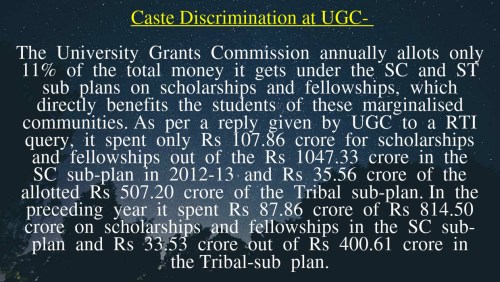
The University Grants Commission annually allots only 11 per cent of the total money it gets under the SC and ST sub plans on scholarships and fellowships, which directly benefits the students of these marginalised communities.

As per a reply given by UGC to a RTI query, it spent only Rs 107.86 crore for scholarships and fellowships out of the Rs 1047.33 crore in the SC sub-plan in 2012-13 and Rs 35.56 crore of the allotted Rs 507.20 crore of the Tribal sub-plan.

In the preceding year it spent Rs 87.86 crore of Rs 814.50 crore on scholarships and fellowships in the SC sub-plan and Rs 33.53 crore out of Rs 400.61 crore in the Tribal-sub plan.

A major chunk of the total money, around 60 per cent, was spent on building “capital assets” which are not specifically beneficial for SC or ST students, like construction of hostels or buying computers.

Caste at UGC

For this reason the UGC has come under fire from Dalit rights organizations.

Mr Paul Divakar, general secretary of National Campaign on Dalit Human Rights, which filed the RTI said, “This is not an issue which pertains just to the UGC. Ineffective spending and diversion of funds meant for SC and ST development exists in many well known institutions like the IITs, IIMs and ICSSR. This is just another form of discrimination. We have complained about the UGC problem to the minister of HRD, Ms Smriti Irani and head of other government bodies, but to no avail. We are planning to approach the courts now.”

When contacted, former UGC chairman Mr Sukhdeo Thorat said, “The allocation of money should be increased for fellowships because it helps the students directly and will result in more Dalit scholars pursuing research. What is the point of allocating money meant under the sub-plans if students do not benefit from it directly?”

Source – Deccan Chronicle

2 Comments

Filed under Caste Discrimination, Casteism, Dalit, Dr B R Ambedkar, India

Caste Discrimination in Public Distribution System (PDS)


Another study in the book ‘Blocked by Caste: Economic Discrimination and Social Exclusion in Modern India’ published in 2010 reports discrimination in Public Distribution System (PDS). fair price shops, are either owned privately or run by cooperatives.

An analysis by Thorat and Lee, drawing on a survey of PDS outlets in 531 villages across five States, shows that there was discriminatory behaviour against Dalits by the PDS staff in respect of prices in 28 per cent of villages and in respect of quality in 40 per cent. In 26 per cent of the villages, dealers practised untouchability “by dropping goods from above into cupped Dalit hands below, so as to avoid ‘polluting contact’.”

Check also – Caste Discrimination in Jobs at Private Sector. What is the caste of your company?

Caste system

Leave a comment

Filed under Caste Discrimination, Casteism, Dalit, Dr B R Ambedkar, Equal Rights, India

Caste Discrimination in Jobs at Private Sector. What is the caste of your company?


For those who say there is no caste discrimination in private job market.

Book “Blocked by Caste: Economic Discrimination and Social Exclusion in Modern India” published in 2010 reports an experiment – 

Thorat and Attewell ran an experiment to test caste discrimination in the urban labour market. For one year, researchers collected advertisements from leading English language newspapers for jobs in the private sector that required a university degree but no specialised skills. The researchers then submitted three false applications for each job. The applicants, all male, had the same or similar education qualification and experience. One of them had a recognisable upper caste Hindu name, another a Muslim name and the third a distinctly Dalit name. The expected outcome was a call for interview or further screening.

An analysis of the outcomes, using regression methods, showed that, although there were an equal number of false applicants from three social groups, for every 10 upper caste Hindu applicants selected for interview, only six Dalits and three Muslims were chosen. Thus, in modern private enterprises (including IT), applicants with a typical Muslim or Dalit name had a lower chance of success than those with the same qualification and an upper caste Hindu name.

For more detail read book named – BLOCKED BY CASTE, ECONOMIC DISCRIMINATION IN MODERN INDIA: Edited by Sukhadeo Thorat, Katherine S. Newman; Oxford University Press

On companies

Here is what Dr. Ambedkar noted almost a century ago, nothing has changed since then.

5 Comments

Filed under Caste Discrimination, Casteism, Dr B R Ambedkar, Equal Rights, India, Reservation