Category Archives: Dalit History Month

Dalit History Month – Remembering Shantabai Krishnaji Kamble


Today’s #DalitHistory month we honor Shantabai Krishnaji Kamble, a Dalit woman writer and teacher. Autobiography is a key form of Dalit literature as we were locked out of many of our larger cultural texts. Through autobiography we could find the mirrors that would represent our struggles and find meaning in the pursuit of our selfhood. Shantabai through her work helped us understand the journey of what it was to be educated and self-realized as a leader and a teacher.
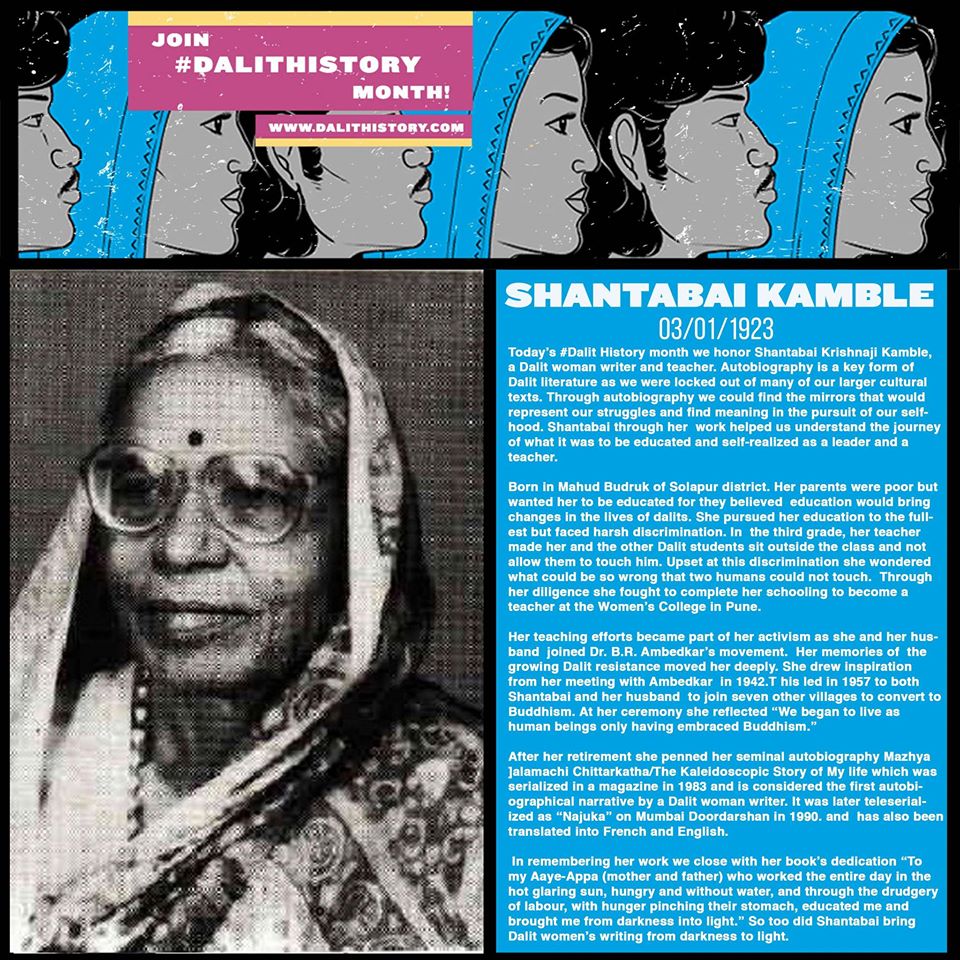
Shantabai Krishnaji Kamble

Shantabai Krishnaji Kamble

Born in Mahud Budruk of Solapur district. Her parents were poor but wanted her to be educated for they believed education would bring changes in the lives of Dalits. She pursued her education to the fullest but faced harsh discrimination. In the third grade, her teacher made her and the other Dalit students sit outside the class and not allow them to touch him. Upset at this discrimination she wondered what could be so wrong that two humans could not touch. Through her diligence she fought to complete her schooling to become a teacher at the Women’s College in Pune.

Her teaching efforts became part of her activism as she and her husband joined Dr. B.R. Ambedkar’s movement. Her memories of the growing Dalit resistance moved her deeply. She drew inspiration from her meeting with Ambedkar in 1942.This led in 1957 to both Shantabai and her husband to join seven other villages to convert to Buddhism. At her ceremony she reflected “We began to live as human beings only having embraced Buddhism.”

After her retirement she penned her seminal autobiography Mazhya ]alamachi Chittarkatha/The Kaleidoscopic Story of My life which was serialized in a magazine in 1983 and is considered the first autobiographical narrative by a Dalit woman writer. It was later teleserialized as “Najuka” on Mumbai Doordarshan in 1990. and has also been translated into French and English.

In remembering her work we close with her book’s dedication “To my Aaye-Appa (mother and father) who worked the entire day in the hot glaring sun, hungry and without water, and through the drudgery of labour, with hunger pinching their stomach, educated me and brought me from darkness into light.” So too did Shantabai bring Dalit women’s writing from darkness to light.

Please share the information with your friends. Follow the Dalit History Month on Facebook from here and check www.dalithistory.com

Leave a comment

Filed under Dalit History, Dalit History Month, Dalit Woman, Dr B R Ambedkar

Dalit History Month – Remembering Purna Malavath and Anand Kumar


Today in Dalit History we focus on Purna Malavath, an Adivasi girl from Telangana, and Anand Kumar, a Dalit boy from Khammam, who in a historic feat for Indian mountaineering became two of the youngest climbers to scale Mount Everest.

13-year old Purna, along with 16-year old Anand, reached the world’s highest peak after an exhausting 52-day expedition up the Tibetan side of the mountain, known to be the most difficult route. On reaching the peak, Purna and Anand unfurled not just India’s flag, but a picture of our leader Dr. B.R Ambedkar. At a time when Dalit children in India are systematically marginalized, excluded, and deprived of educational opportunities, Purna’s and Anand’s victories are truly epic. Their achievement is testament to the potential every Dalit child possesses, and if provided with resources, will accomplish what they aspire to.

Purna

On their victory, Purna said, “The aim of my expedition was to inspire young people and students from my kind of background. For a tribal like me, opportunities are very rare and I was looking for one opportunity where I could prove my caliber”. During tough times of the expedition, Purna narrates that she kept herself motivated, by thinking of her parents, whose words, “you can change your life if you put your mind to it” kept her going.

Check alsoDalit History Month – Jhalkari Bai – A Legendary Dalit Woman Warrior

Purna’s parents are agricultural laborers from Telangana; her co-climber Anand’s father is a cycle mechanic. “My father is my hero. He never once complained about his work at the cycle shop and always encouraged me to work hard, no matter how big or small the task,” says Anand.

The journey for both of them began at the Andhra Pradesh Social Welfare Residential Educational Institutions. Purna and Anand was selected from a group of more than 100 students who were sent for training to the Himalayan Mountaineering Institute in Darjeeling. In preparation for the Everest climb, they trained in the mountains of Darjeeling and Ladakh.

In June 2014, Purna and Anand were recognized for their achievement by the National Campaign on Dalit Human Rights in association with the All India Dalit Rights Federation, the Centre for Social Equity and Inclusion, AP Bhavan Employees’ Welfare & Cultural Association, and AP Bhavan SC/ST Welfare Association.

Read also – 

“We believe that if Dalit children are given equal opportunities, they can excel anywhere. They only need support to utilize these opportunities effectively”, said Beena Pallical, National Coordinator for Campaigns, NCDHR. “We dream of an India where every child’s potential is realised so that they can be where Poorna is today. At the top”, added Annie Namala of the Centre for Social Equity and Inclusion.

Please share the information with your friends. Follow the Dalit History Month on Facebook from here and check www.dalithistory.com

2 Comments

Filed under Dalit History, Dalit History Month, Dr B R Ambedkar, Today in Dalit History, Today in History

Dalit History Month – Remembering Mahatma Jotiba Phule


Today in Dalit History, in honor of Mahatma Phule Jayanthi, or birthday, we dedicate our post to Jyotirao Phule – an activist, a thinker, and a social revolutionary of the nineteenth century.

While he was not of a Dalit but a Shudra background, his ideals, works and actions have had an invaluable liberatory impact on Dalits.

Born April 11th 1827 before the widespread Adi-movements, Phule was the first to propound caste as a subjugation and oppression on an indigenous peoples by invaders. He stressed that caste was equivalent to slavery, as vicious and brutal as the enslavement of Africans in the Americas and unique in its deception and religious sanction.

Check alsoDalit History Month – Jhalkari Bai – A Legendary Dalit Woman Warrior

Mahatma Jotiba Phule

Mahatma Jotiba Phule

In his revolutionary book, Gulamgiri (Slavery) published in 1873, Jyotirao included a manifesto which amongst other things declared that he was willing to dine with all regardless of their caste, creed or country of origin and that social salvation was to be found only in the education of women and Dalits. This content was deemed extremely controversial at the time and several newspapers blatantly refused to publicize it.

He believed that Dalits were a group of people who had suffered added repression and persecution because they had at one time been actively engaged in fighting invading Brahmanism on the ground. His salvation describes the unity of the Shudras and Adi-Shudras (Dalits) into one exploited mass of people rising up in powerful political unity.

Read also – 

He and his wife, Savitribai Phule, became pioneers of women’s education in India, and together started the first school for girls on January 1st 1848 at Bhide’s wada in Pune. They also started schools in which they educated both girls and Dalits.

Like most Dalit and anti-caste revolutionaries, he felt a strong need to establish an alternative religion to the one that was oppressing his people. What he began then, lead him to form the Satya Shodhak Samaj (Society of Seekers of Truth) whose main objectives were to liberate the Shudras and Ati Shudras and prevent exploitation by Brahmins within a strong context of gender equality.

His life-long work for equality has recognized when Phule was publicly conferred the title of Mahatma on 11 May 1888 and later termed the “Martin Luther King of India” by his biographer Dhananjay Keer. Dr.Ambedkar proudly declared that Phule was one his three spiritual mentors. His birthday continues to be a celebration all around the world where Dalits honor him for Mahatma Phule Jayanthi.

Read also – Dalit History Month – Jhalkari Bai – A Legendary Dalit Woman Warrior

Please share the information with your friends. Follow the Dalit History Month on Facebook from here and check www.dalithistory.com

1 Comment

Filed under Dalit History, Dalit History Month, Dr B R Ambedkar, Mahatma Jotiba Phule, Today in Dalit History, Today in History

Dalit History Month – Remembering “Adi Movements”


Today’s ‪Dalit History‬ month post is on the Adi-movements of the 1920’s. For Dalit history, ‘Adi’ ideologies are highly significant as they bear testament to our earliest assertion of equal rights, humanity and citizenship on level with other castes.

By the late 19th century, leaders like the social reformer Jyotirao Phule, had created a powerful anti-caste space, upholding non-Brahmanical thought and presenting the dream of a new egalitarian value system on which to model society on. Soon after, the early 20th century saw several archaeological discoveries being made in Mohenjodaro and Harappa in the North, pointing to the existence of an unexpectedly ancient civilization that was likely much older than Aryan migrations. These discoveries struck a profound chord with Dalits all over the subcontinent, who immediately began to identify as an indigenous population who were conquered and subsequently oppressed by an alien religion. Although, the evidence for Aryan conquests remains contested, these interpretation was so compelling that such “Adi” (Ancient/Old/Original) movements sprung up all over the nation completely independently of each other.

Check alsoDalit History Month – Jhalkari Bai – A Legendary Dalit Woman Warrior

Adi movement

The names of these movements are telling – Ad-Dharm in Punjab, Adi-Hindu in U.P. and Hyderabad, Adi-Dravida, Adi-Andhra and Adi-Karnataka in South India – all indicating a common claim to nativity and original inhabitation.

Read also – 

The provocative effects of the Adi-movements are best illustrated by an early Maharashtrian pre-Ambedkar Dalit leader, Kisan Faguji Bansode, who warned his caste-Hindu friends in 1909, stating: “The Aryans – your ancestors – conquered us and gave us unbearable harassment. At that time we were your conquest, you treated us worse than slaves and subjected us to any torture you wanted. But now we are no longer your subjects, we have no service relationship with you, we are not your slaves or serfs… We have had enough of the harassment and torture of the Hindus.”

Continue reading

Leave a comment

Filed under Dalit History, Dalit History Month, Dr B R Ambedkar, Today in Dalit History, Today in History

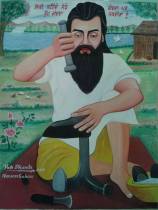
Dalit History Month – Remembering Shri Guru Ravidas Ji


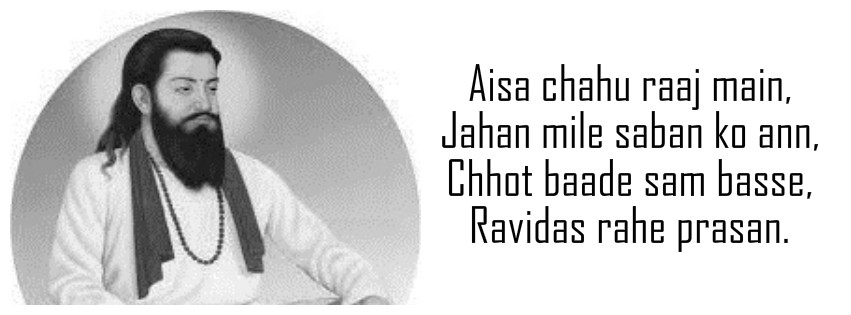
Today’s ‪‎Dalit History‬ post focuses on Guru ‪Ravidass‬. He represents one of many Dalit saints within our liberatory spiritual traditions who challenge Hinduism and its painful notions of pollution. These thinkers fearlessly explored the existential questions posed by caste apartheid with their counter vision of justice, freedom, and one’s true place in the universe.

Ravidas2

Guru Ravidas

Guru Ravidass was one such towering figure. A Chamar saint, poet, and philosopher, he called himself a ‘tanner now set free’. He was the first to envision an Indian utopia in his song “Begumpura”—a modern casteless, classless, tax-free city without sorrow. This vision was in stark contrast to the dystopia of the Brahmanical Kali Yuga.

Check also I, Ravidas, proclaim all Vedas are worthless.

Emerging from the Bhakti tradition he employed loving devotion as a method of social protest against Untouchability. The path he chose was free from religious rituals and sectarian formalities. It emphasized the dignity of labour and compassion for all. It reflected the democratic and egalitarian traits of his social philosophy. He dared challenging the tyranny of the Brahmin spiritual hegemony by wearing dhoti (cloth wrapped around the waist), the janeue (sacred thread), and tilak (sacred red mark on forehead).

His poetry became one of the main vehicles of his social protest. Written in the vernacular of the common man, he hoped to “provide for a better world and a fight against exploiters, power-holders and oppression going on under the name of religion”.

Check alsoPhotos and what Guru Ravidas Ji said

His spiritual teachings became a catalyst that helped concretize the Dalit cultural space in Punjab as his followers have grown beyond India to the world. The followers of his path, represent a range with some devotees counting themselves as Ravidassi Sikhs, while the vast majority now consider themselves a separate religion from Hinduism and Sikhism. One of the key defining characteristics of Ravidassias is that they must believe that Ravidass is a guru (saint) whereas the Sikhs consider him a merely bhagat (holy person). Ravidassias also have compiled their own holy book of Ravidass’ teachings, the Amritbani Guru Ravidass Ji, and many Ravidassia temples now use this book in place of the Guru Granth Sahib.

Check also – Stop Attacking Dalit Statues and Dalit Pride

Please share the information with your friends. Follow the Dalit History Month on Facebook from here and check www.dalithistory.com
Check also

1 Comment

Filed under Dalit History, Dalit History Month, Dr B R Ambedkar, Guru Ravidas, Today in Dalit History

Dalit History Month – Remembering Madhu Bai Kinnar


Dalit History is vital for understanding tour vibrant parallel culture that defiantly exists next to more conventionally taught Brahmin history for our countries in South Asia.

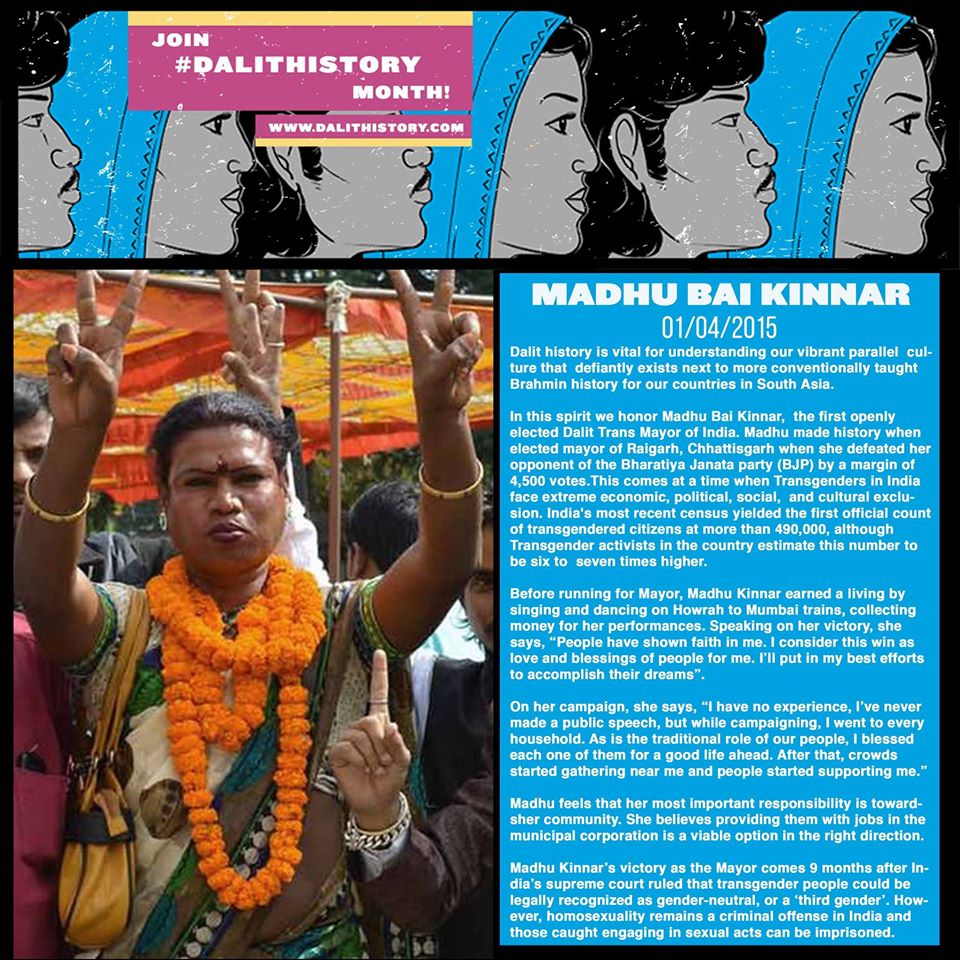
In this spirit today’s dalit history post honors Madhu Bai Kinnar, the first openly elected Dalit Trans Mayor of India. Madhu made history when elected mayor of Raigarh, Chhattisgarh when she defeated her opponent of the Bharatiya Janata party (BJP) by a margin of 4,500 votes.

Check alsoDalit History Month – Jhalkari Bai – A Legendary Dalit Woman Warrior

Madhu Bai Kinnar

Madhu Bai Kinnar

This comes at a time when Transgenders in India face extreme economic, political, social, and cultural exclusion. India’s most recent census yielded the first official count of transgendered citizens at more than 490,000, although Transgender activists in the country estimate this number to be six to seven times higher.

Read also – 

Before running for Mayor, Madhu Kinnar earned a living by singing and dancing on Howrah to Mumbai trains, collecting money for her performances. Speaking on her victory, she says, “People have shown faith in me. I consider this win as love and blessings of people for me. I’ll put in my best efforts to accomplish their dreams”.

On her campaign, she says, “I have no experience, I’ve never made a public speech, but while campaigning, I went to every household. As is the traditional role of our people, I blessed each one of them for a good life ahead. After that, crowds started gathering near me and people started supporting me.”

Madhu feels that her most important responsibility is towards her community. She believes providing them with jobs in the municipal corporation is a viable option in the right direction.

Read alsoDalit History Month – The Dalit Panthers

Madhu Kinnar’s victory as Mayor comes 9 months after India’s supreme court ruled that transgender people could be legally recognized as gender-neutral, or a ‘third gender’. However, homosexuality remains a criminal offense in India and those caught engaging in sexual acts can be imprisoned.

Read also – 

Leave a comment

Filed under Dalit History, Dalit History Month, Dalit Woman, Dr B R Ambedkar, Equal Rights

Dalit History Month – Remembering Tsundur Massacre


Our Dalit History post for today is on the terrible Tsundur Massacre.

The history of Dalits is haunted by the heartbreaking reality of Caste atrocity. India and the other South Asian countries where Caste is rampant, maintain Caste apartheid through Caste lynchings, massacres, and public rapes and beatings. This violence is a vicious reprisal message to Dalits who challenge caste norms- creating a vicious climate of terror. However the reason we know and remember these crimes, is through the remarkable activism of the survivors and their families.

The Tsundur massacre is an example of one such case. Tsundur (or Chundhur) is a village dominated by the Reddy caste in Vijayawada, Andhra Pradesh (pop. 5,800). After a series of escalating small caste skirmishes the violence broke out in full force on the morning of August 6th, where police who were colluding with the perpetrator warned Dalits an attack was imminent and asked them to flee to the fields.

Read alsoDalit History Month – The Dalit Panthers

Tsundur Massacre

Tsundur Massacre

They did this to have the Dalits come out into the open so that the 400 dominant Caste villagers who were waiting in the fields and forests, beat the Dalits with iron rods, and stabbed them with daggers and axes. The Reddys then gathered the bodies and packed them into gunny bags and tossed them into the nearby Tungabhadra drain. In all, at least 8 Dalit men were stabbed or beaten to death, and 7 others whom have never been traced are believed dead. The police made no effort to recover the bodies of those killed.

Read also – 

In the wake of this attack the families and Dalit Movements throughout Andhra Pradesh fought tirelessly to bring these Caste criminals to justice. The first ever special atrocity court was convened onsite to try these perpetrators. However, despite an initial set of convictions, The Supreme Court of India in July 2014 stayed all further proceedings and justice has repeatedly been denied. We salute and honor the memory of the slain and their families who continue to carry on the fight.

Read also – 

Please share the information with your friends. Follow the Dalit History Month on Facebook from here and check www.dalithistory.com
1 Comment

Filed under Dalit History, Dalit History Month, Dr B R Ambedkar, Equal Rights

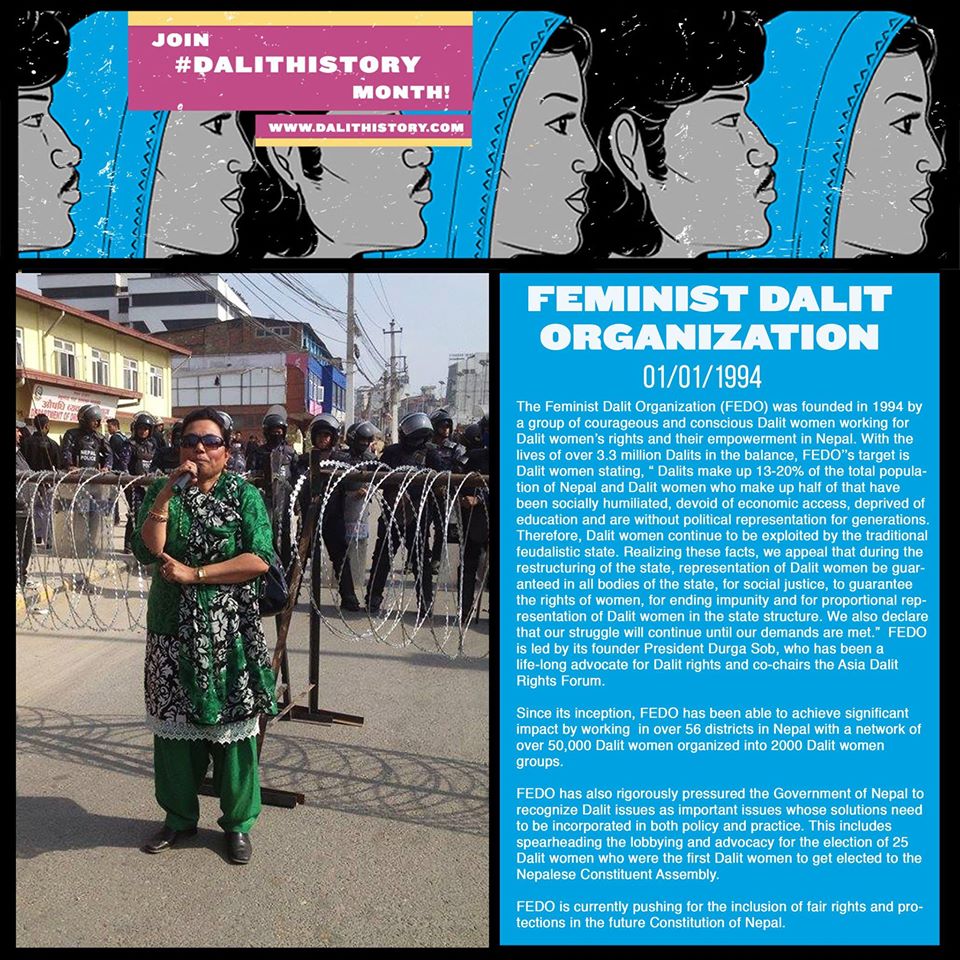
Dalit History Month – Remembering Feminist Dalit Organization


Today’s Dalit History post is a reminder that Dalits are not limited to India. Dalit’s in fact are found all over South Asia and their experiences of caste discrimination are hidden within the larger histories of our countries. In that spirit we share the trailblazing work of the Feminist Dalit Organization (FEDO) which was founded in 1994 by a group of courageous and conscious Dalit women working for Dalit women’s rights and their empowerment in Nepal. With the lives of over 3.3 million Dalits in the balance, FEDO’’s target is Dalit women stating, “ Dalits make up 13-20% of the total population of Nepal and Dalit women who make up half of that have been socially humiliated, devoid of economic access, deprived of education and are without political representation for generations. Therefore, Dalit women continue to be exploited by the traditional feudalistic state. Realizing these facts, we appeal that during the restructuring of the state, representation of Dalit women be guaranteed in all bodies of the state, for social justice, to guarantee the rights of women, for ending impunity and for proportional representation of Dalit women in the state structure. We also declare that our struggle will continue until our demands are met.” FEDO is led by its founder President Durga Sob, who has been a life-long advocate for Dalit rights and co-chairs the Asia Dalit Rights Forum.

Check alsoDalit History Month – Jhalkari Bai – A Legendary Dalit Woman Warrior

Feminist Dalit Organization

Feminist Dalit Organization

Since its inception, FEDO has been able to achieve significant impact by working in over 56 districts in Nepal with a network of over 50,000 Dalit women organized into 2000 Dalit women groups.

FEDO has also rigorously pressured the Government of Nepal to recognize Dalit issues as important issues whose solutions need to be incorporated in both policy and practice. This includes spearheading the lobbying and advocacy for the election of 25 Dalit women who were the first Dalit women to get elected to the Nepalese Constituent Assembly.

Read alsoDalit History Month – The Dalit Panthers

FEDO is currently pushing for the inclusion of fair rights and protections in the future Constitution of Nepal.

Please share the information with your friends. Follow the Dalit History Month on Facebook from here and check www.dalithistory.com

1 Comment

Filed under Dalit History, Dalit History Month, Dr B R Ambedkar, Today in Dalit History, Today in History