Tag Archives: Dr Ambedkar

Dalit History Month – Dalit, Queer, Proud


On 29th November 2015, three young queer Dalits changed the face the Delhi queer pride. Dhrubo Jyoti, a journalist, Akhil Khang, a lawyer and Dhiren Borisa, a doctoral student, held up beautiful signs that they had painted. The signs summarized in three powerful words, ” Dalit, Queer, Proud”. In one extraordinary moment, both their Dalit and the Queer identities were visibilized and celebrated. Their assertion also dealt a blow to upper caste hegemony over Queer spaces like the Delhi Pride.

In reality, poor and especially trans and genderqueer Dalitbahujan contributions surpass upper caste efforts at queer liberation. They are the ones who create queer communities, protest enmasse and bear the brunt of the beatings, torture, rape and murders by society and the state. The criminalizing of the lives of queer folks through oppressive acts like the Section 377 (colonial anti-homosexuality law) also disproportionately affects poor, queer Dalitbahujan individuals, who cannot afford the price of privacy or rely on sex work for a living.

The prides in major cities however, had become reflective of upper caste queer activism whose proponents have strived to create “caste-less” spaces to dissociate queerness from caste. In Dhrubo’s pride speech, he states his reply to an upper caste individual asking him why Dalits felt the need to “bring caste into everything”. Dhrubo replies ” We bring caste up because caste is everywhere and in my everything, Caste is in my shirt, Caste is in my pant, Caste is in my sex, Caste is in my being and Caste is in every part of you too!” Together, their compelling Pride statement affirmed that the invisibilization of caste, erased Dalitbahujan struggles, history and identity

Their statement was not met without hostility. The majority of dominant castes accused them of derailing conversations of queerness with caste, but they made clear their position was one that was not posing to ease upper caste fragility but one that would help nurture inclusion.

They continue to engage by being conscious of their own privileges, by being a part of the interrogation of power structures and by opposing the prevailing silence around caste and queerness that shames Dalit queer folk into silence.

Today in Dalit History, we honor the energy of these three resolute young individuals and celebrate both their queerness and their Dalitness as they continue to enlighten us and make us proud!

Dalit History

Leave a comment

Filed under Dalit, Dalit History, Dalit History Month, Dalit Woman, Dr B R Ambedkar

Dalit History Month – Remembering Advocate Eknath Awad


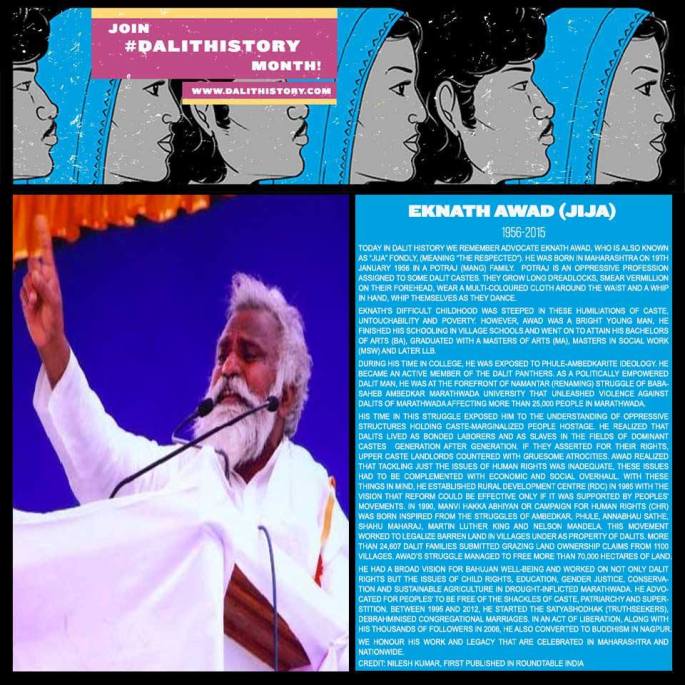
Today in Dalit History we remember Advocate Eknath Awad, who is also known as “Jija” fondly, (meaning “the respected”). he was born in Maharashtra on 19th January 1956 in a Potraj (Mang) family. Potraj is an oppressive profession assigned to some Dalit castes. They grow long dreadlocks, smear vermillion on their forehead, wear a multi-coloured cloth around the waist and a whip in hand, whip themselves as they dance.

Eknath’s difficult childhood was steeped in these humiliations of caste, untouchability and poverty. However, Awad was a bright young man, he finished his schooling in village schools and went on to attain his Bachelors of Arts (BA), graduated with a Masters of Arts (MA), Masters in Social Work (MSW) and later LLB.

During his time in college, he was exposed to Phule-Ambedkarite ideology. He became an active member of the Dalit Panthers. As a politically empowered Dalit man, he was at the forefront of Namantar (renaming) struggle of Babasaheb Ambedkar Marathwada University that unleashed violence against Dalits of Marathwada affecting more than 25,000 people in Marathwada.

His time in this struggle exposed him to the understanding of oppressive structures holding caste-marginalized people hostage. He realized that dalits lived as bonded laborers and as slaves in the fields of dominant castes generation after generation. If they asserted for their rights, upper caste landlords countered with gruesome atrocities. Awad realized that tackling just the issues of human rights was inadequate, these issues had to be complemented with economic and social overhaul. With these things in mind, he established Rural Development Centre (RDC) in 1985 with the vision that reform could be effective only if it was supported by peoples’ movements. In 1990, Manvi Hakka Abhiyan or Campaign for Human Rights (CHR) was born inspired from the struggles of Ambedkar, Phule, Annabhau Sathe, Shahu Maharaj, Martin Luther King and Nelson Mandela. This movement worked to legalize barren land in villages under as property of Dalits. More than 24,607 Dalit families submitted grazing land ownership claims from 1100 villages. Awad’s struggle managed to free more than 70,000 hectares of land.

He had a broad vision for Bahujan well-being and worked on not only Dalit rights but the issues of child rights, education, gender justice, conservation and sustainable agriculture in drought-inflicted Marathwada. He advocated for peoples’ to be free of the shackles of caste, patriarchy and superstition. between 1995 and 2012, he started the satyashodhak (truthseekers), debrahminised congregational marriages. in an act of liberation, Along with his thousands of followers in 2006, he also converted to Buddhism in Nagpur.

We honour his work and legacy that are celebrated in Maharashtra and nationwide.

Credit – Nilesh Kumar First published in Round Table India

Advocate Eknath Awad

Leave a comment

Filed under Dalit, Dalit Bahujan Ideals, Dalit History, Dalit-Bahujans, Dr B R Ambedkar

Challenges faced by Dr. Ambedkar to write the Constitution of India


Written by – Ashwin Jangam

Indians today are governed by two different ideologies. Their political ideal set in the preamble of the Constitution affirms a life of liberty, equality and fraternity. Their social ideal embodied in their religion denies them. ~Dr. B.R. Ambedkar

Every year on 26 January, we celebrate Constitution Day, also known as Samvidhan Divas, in India in honor of Dr. Bhimrao Ramji Ambedkar, the Architect of the Indian constitution.

Constitution Drafting Committee

Dr. Ambedkar

Dr. Ambedkar

India obtained independence on 15 August 1947 as a constitutional monarchy with George VI as Head of State and the Earl of Mountbatten as its Governor-General. The country, though, did not yet had a constitution; instead, its laws were based on the modified colonial Government of India Act of 1935. On 29 August 1947, a resolution was passed by the Constituent Assembly to appoint a Drafting Committee with seven members, including Dr. Ambedkar, for preparing a draft of the Constitution of independent India. It is said that when Pandit Jawaharlal Nehru and Sardar Vallabhbhai Patel asked Sir Guor Jennings, an internationally-known constitutional expert of that time to draft the Constitution of India, he responded, “Why are you looking outside of India when you have within India an outstanding legal and constitutional expert in Dr. Ambedkar who ought to be entrusted with the role which you so badly need and which he so richly and rightly deserves?”

Committee Membership

Then Law Minister Dr. Ambedkar was appointed the Chairman of the Drafting Committee on 28 August 1947 because of his educational qualifications and deep knowledge, great command of the English language, and expertise in articulating the subject. Other members of the Drafting Committee were N. Goipalswami, Alladi Krishnaswami Ayyas, K.M. Munshi, Saijio Mola Saadulla, N. Madhava Rao and D.P. Khaitan.

Check also – 

Member Responsibilities

The workload of drafting the Constitution of India fell entirely on Dr. Ambedkar and required his full effort and concentration. The other members of the Constitution Committee did not participate for various reasons. Some resigned, some were in ill health, some were busy with political work in their respective States, some were traveling abroad, and so on. It is generally agreed that Dr. Ambedkar was the sole author of the Constitution of India. We Indians owe a debt of gratitude to Dr. Ambedkar for such a perfect Constitution which is still in effect after 60 years of Indian Independence.

In his self-evaluation of his work, Dr. Ambedkar told the Assembly, “I do not want to say how good or bad is the Constitution. I feel that it is as much good as bad. It will be bad in the end when the ruling people/party are bad. It will be good in the end when the ruling people/party are good.”

Check also –  

Continue reading

Leave a comment

Filed under BSP, Caste Discrimination, Constitution of India, Dalit, Dr B R Ambedkar

Dr. Ambedkar on Muslims/Islam, he wasn’t anti-Muslim


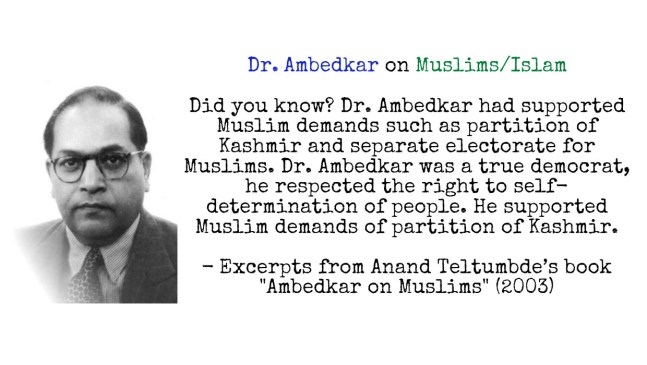
Did you know? Dr. Ambedkar had supported Muslim demands such as partition of Kashmir and separate electorate for Muslims. Dr. Ambedkar was a true democrat, he respected the right to self-determination of people. He supported Muslim demands of partition of Kashmir.

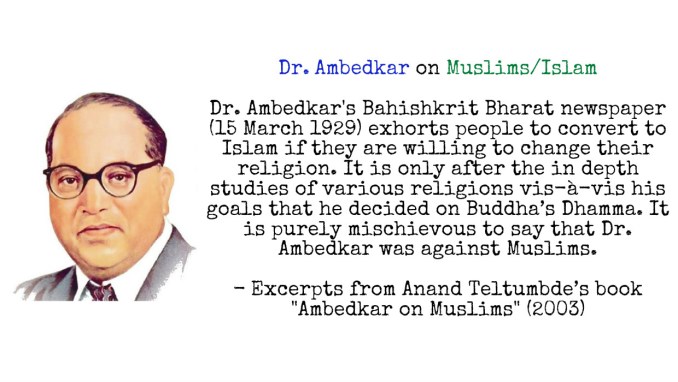
Dr. Ambedkar’s Bahishkrit Bharat newspaper (15 March 1929) exhorts people to convert to Islam if they are willing to change their religion. It is only after the in depth studies of various religions vis-à-vis his goals that he decided on Buddha’s Dhamma. It is purely mischievous to say that Dr. Ambedkar was against Muslims.

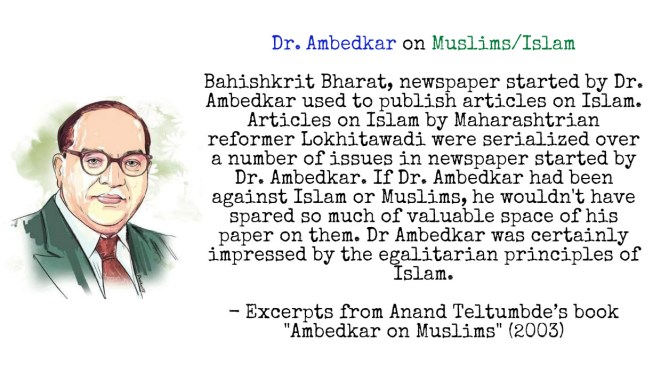
Did you know? Dr. Ambedkar wasn’t anti-Muslim. Bahishkrit Bharat, newspaper started by Dr. Ambedkar used to publish articles on Islam. Articles on Islam by Maharashtrian reformer Lokhitawadi were serialized over a number of issues in newspaper started by Dr. Ambedkar. If Dr. Ambedkar had been against Islam or Muslims,he wouldn’t have spared so much of valuable space of his paper on them. Dr Ambedkar was certainly impressed by the egalitarian principles of Islam.

– Excerpts from Anand Teltumbde’s book Ambedkar on Muslims (2003)

Sanghis are lying as usual. Dr. Ambedkar wasn’t anti-Muslim. How can a democratic person hate anyone?

Dr. Ambedkar on Islam Dr. Ambedkar on Muslim Dr. Ambedkar on muslims and islam Dr. Ambedkar on Muslims

1 Comment

Filed under Caste Discrimination, Dalit, Dr B R Ambedkar, Photos

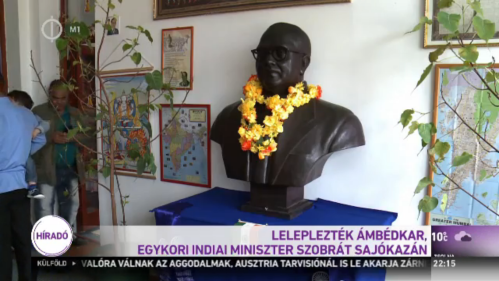
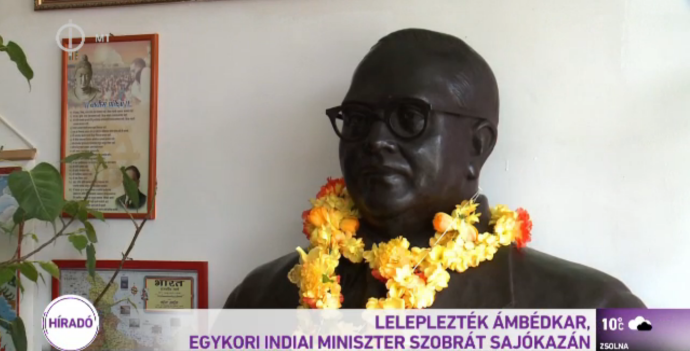
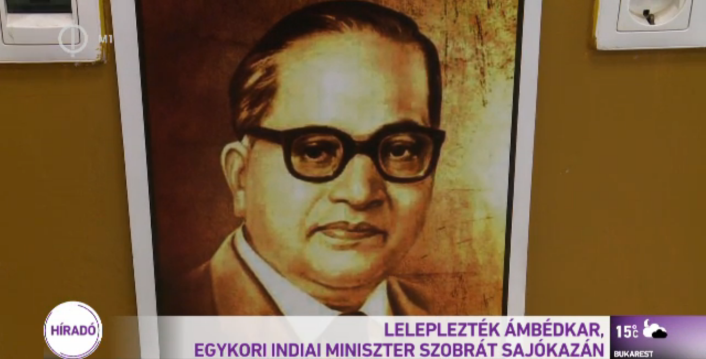
First Dr. Ambedkar statue installed at the heart of Europe – Hungary!


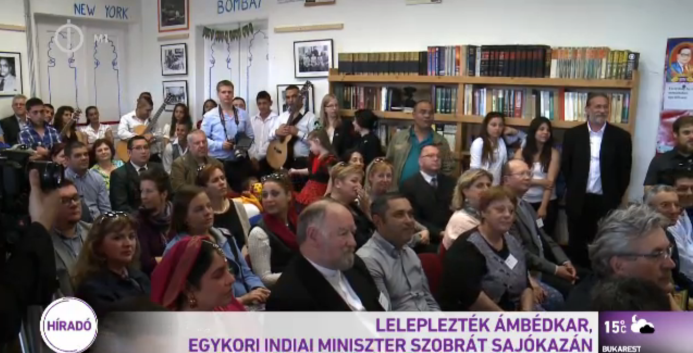
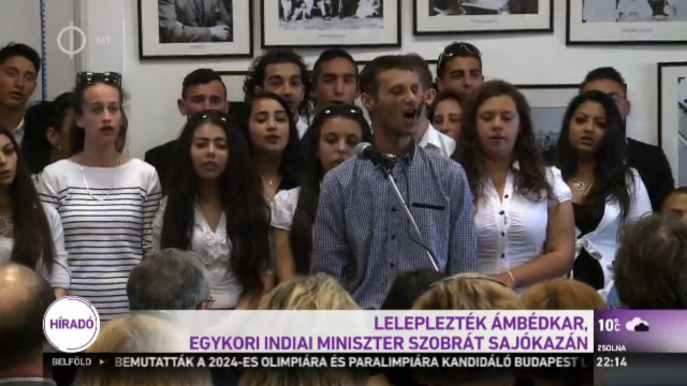
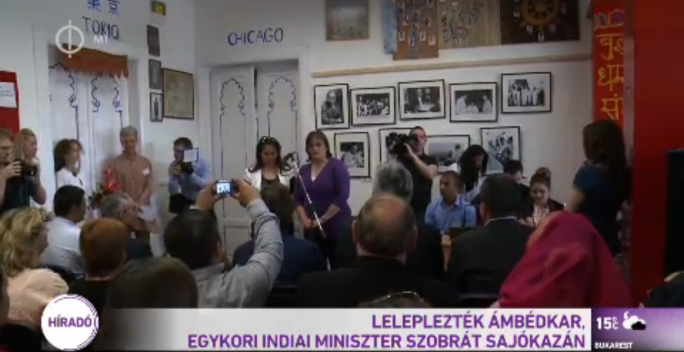
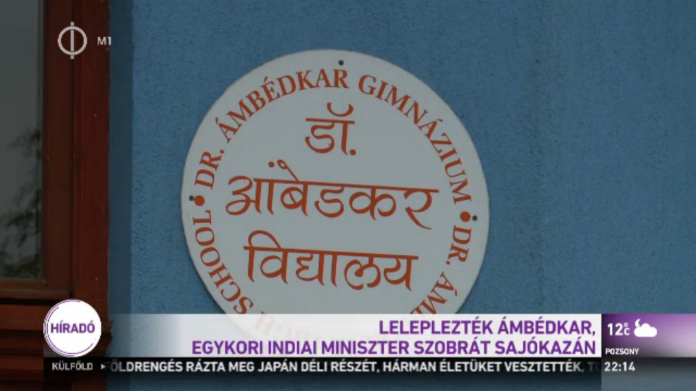
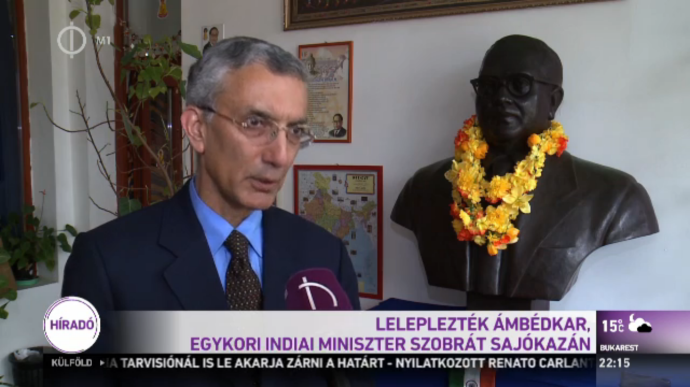
On 14th April, 2016, at Dr. Ambedkar School in Sajokaza, Hungary, Dr. Ambedkar’s statue was installed by Jai Bhim Network.

Jai Bhim Network is inspired by Dr. Ambedkar and is running many schools for the untouchables of Europe – Roma people. Jai Bhim Network started to work in 2006 and has been able to establish itself as a leader in raising the Roma students’ issues. All this has become possible because of the whole Jai Bhim Network team working day and night at Sajokaza. Read alsoDr. Ambedkar in Hungary 

Dr. Ambedkar’s statue in Hungary – at the heart of Europe – is first in the central Europe.

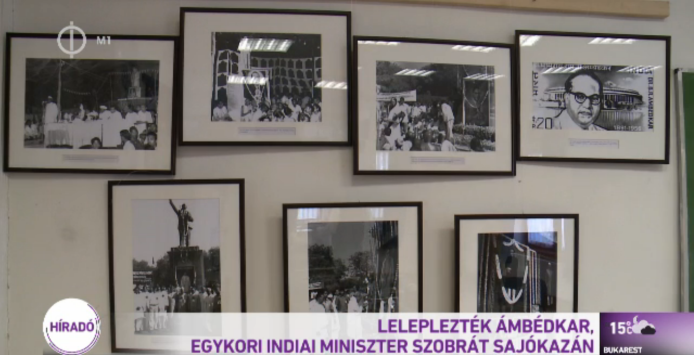
Jai Bhim Network celebrates Dr. Ambedkar Jayanti every year. Hungarian media cover the event. Here are a few pictures from the celebration and pictures of the statue.

Dr. Ambedkar's statue at Sajokaza, Hungary

Dr. Ambedkar Statue at Hungary

Dr. Ambedkar Jayanti Celebration at Hungary

Dr. Ambedkar Jayanti Celebration at Hungary

Dr. Ambedkar Jayanti Celebration at Hungary

Dr. Ambedkar Jayanti Celebration at Hungary

Dr. Ambedkar Jayanti Celebration at Hungary

Dr. Ambedkar Jayanti Celebration at Hungary

Dr. Ambedkar Jayanti Celebration at Hungary

Dr. Ambedkar Jayanti Celebration at Hungary

Dr. Ambedkar Jayanti Celebration at Hungary

Dr. Ambedkar School at Hungary

Dr. Ambedkar School at Hungary

Dr. Ambedkar School at Hungary

Dr. Ambedkar School at Hungary

Dr. Ambedkar School at Hungary

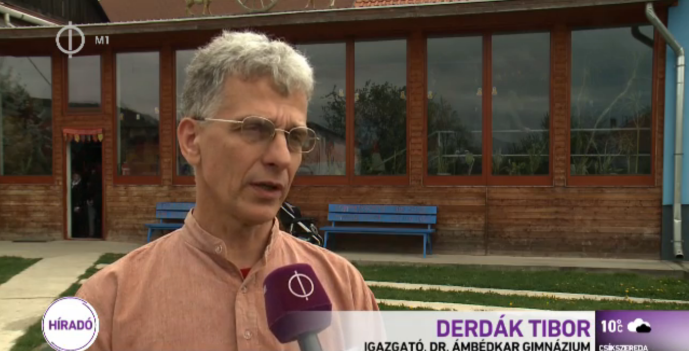
Director of Jai Bhim Network – Derdak Tibor

Dr. Ambedkar School at Hungary

Dr. Ambedkar School at Hungary

Dr. Ambedkar at Hungary

Indian Ambassador to Hungary

4 Comments

Filed under Dalit, Dr B R Ambedkar, Photos

United Nations to celebrate Dr. Babasaheb Ambedkar’s Jayanti but at what cost?


Celebrating Dr. Ambedkar’s birthday at United Nations. Good. I don’t have any problem with it. He should be recognized. I support that and support those organisations also working behind it.
BUT
2030 Sustainable Development Goals were adopted by UN without any reference to millions impoverished and excluded due to caste discrimination.

We should be outrageous against this discrimination. It’s important to recognize Dr. Ambedkar but more than that it’s important that caste discrimination ends in India. What I believe is we should focus more on putting pressure on United Nations to work on ending caste discrimination. We need to set our priorities rights if we want to achieve our targets.

And I pity those organisations also those don’t have any clue that SDGs 2030 don’t include ‘caste discrimination’ but are commenting on this. Which SDGs UN is talking about? SDGs those don’t have any reference to millions impoverished & excluded due to caste?

If UN hasn’t recognized caste discrimination to be ended in 2030 SDGs then which inequality UN is combating? UN has always fooled people on the name of combating inequalities, stop fooling & end caste discrimination.

Dr Ambedkar Wallpapers Photos

Leave a comment

Filed under Caste Discrimination, Casteism, Dalit, Dr B R Ambedkar

Watch what Amir Khan said about Babasaheb Ambedkar


You should also not forget that ‘Untouchability – Dignity For All’ episode of Satyamev Jayate show on 8th July, 2012, Actor Amir Khan didn’t even mention Dr. Ambedkar’s name and here is his yesterday’s speech.

2 Comments

Filed under Casteism, Dalit, Dr B R Ambedkar, video

Osho speaks on Dr. Ambedkar, Gandhi, and Dalits


In this speech, Osho higly praises Dr.Ambedkar and speaks on the injustice done to Dalits (Untouchables) in various fields. He says that there was no one equally intelligent to Dr.Amedkar in his time as far as constitutions were concerned. Osho also remembers the Poona Pact and criticizes Gandhi over his suicidal fast in order to achieve his goal. He calls the Gandhi’s fast as blackmail. Listen to know more.

2 Comments

Filed under Caste Discrimination, Casteism, Constitution of India, Dalit, Dr B R Ambedkar, video