Category Archives: Buddhism

Audio Biography on the life of Dr B R Ambedkar in Marathi


Watch movie on Dr. B. R. Ambedkar in Hindi, English and Tamil from here.

4 Comments

Filed under Buddha, Buddhism, Dalit-Bahujans, Documentary, Dr B R Ambedkar, India, Movie

What Dr. Ambedkar said on Constitution at Parliament – A clip from Dr. Babasaheb Ambedkar Movie


“I feel that the constitution is workable, it is flexible and it is strong enough to hold the country together both in peacetime and in wartime. Indeed, if I may say so, if things go wrong under the new Constitution, the reason will not be that we had a bad Constitution. What we will have to say is that Man was vile.”

Also watch –

Related articles –

3 Comments

Filed under Buddhism, Dalit-Bahujans, Dr B R Ambedkar, Equal Rights, India, Today in Dalit History, Today in History

Movie on Ramabai Bhimrao Ambedkar – Ramai


This movie is a biography of Ramabai Bhimrao Ambedkar also known as Ramabai wife of Dr. Babasaheb. Ramabai lost her parents at a very young age and brought up her two young brothers all alone. She was brought to Mumbai by her uncles and married off to Bhimrao Ambedkar at the young age. Ramabai’s father-in-law and brother-in-law passed away soon after her marriage. Around the same time, Bhimrao left for London after getting a scholarship for higher studies, leaving the responsibility of running the household on Rambai. Despite all the hardships, Rambai kept her husband motivated and also sent him pocket money regularly. Losing her infant children one by one did not stop Ramabai from standing like a rock behind her husband’s mission of uplifting the underprivileged classes of the country.

Watch movie on Dr. B. R. Ambedkar in Hindi, Tamil and English from here and listen to the songs on Dr. B. R. Ambedkar from here.

Related articles:

3 Comments

Filed under Buddha, Buddhism, Dalit-Bahujans, Documentary, Dr B R Ambedkar, Equal Rights, India, Movie

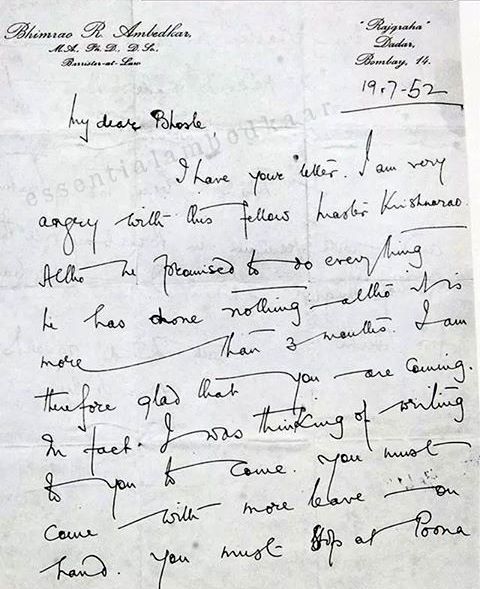
Dr. B. R. Ambedkar’s hand written letter


Dr. B. R. Ambedkar's hand written letter.

Dr. B. R. Ambedkar’s hand written letter.

6 Comments

Filed under Buddhism, Dalit-Bahujans, Dr B R Ambedkar, Equal Rights, India

Dr. Ambedkar in Germany


In recent years, Dr. Ambedkar (1891-1956), India’s great Dalit leader, social reformer and first law minister after independence has gained increasing recognition in academic and political circles in Germany. Within the realm of scholarship at the South Asia Institute, his mediating role in the framing of the Indian Constitution has been adequately recognized (Kulke, Rothermund 1998: 394) as well as the implementation of constitutional safeguards for the Scheduled Castes and Scheduled Tribes (Conrad 1995: 419) through so-called reservation of seats in politics, education and administration. His political role, especially the social movement initiated by him, has been subject to a dissertation in political sciences (Hust 2000) as well as part of a more elaborate discourse on the part of Dalits in social movements in India (Fuchs 1999; 2003).

In the fields of German Indology and History of Religion, Dr. Ambedkar’s conversion to Buddhism at the end of his life caught considerable academic attention. His cast of Buddhism was understood as theology of liberation (Gensichen 1995: 197) as well as an original development under the heading of civil religion (Fuchs 2001: 205). In addition, fieldwork among Mahars in Maharashtra focussed on the social relevance of Dr. Ambedkar’s Navayana Buddhism (Beltz 2001). Textual studies focussed on a comparison of Buddhist sources with Dr. Ambedkar’s “The Buddha and His Dhamma” (Buss 1998; Fiske/Emmrich forthcoming), projecting Dr. Ambedkar’s cast of Buddhism as an effort to reconstruct the world  (Beltz/ Jondhale forthcoming).

Also Read – Dr. Ambedkar in Hungary and  Dr. Ambedkar in America 

Ambedkar studies apart, the concern with Dalits has been the focus of a number of studies in social anthroplogy in the urban (Bellwinkel 1980) as well as the rural setting (Randeria 1993) setting. The most comprehensive project in this respect was an interdisciplinary research project, financed by the Volkswagen Foundation and linked with the Department of Modern Indology, South Asia Institute and the Department of Sociology, Delhi University. Under the heading of “Memory, Violence and the Agency”,  the topic was the role of Dalits as victims and perpetrators in Bombay and Kanpur (Fuchs forthcoming).This project set an example for the Memorandum of Understanding between Heidelberg University and Delhi University in common fieldwork for the  exchange of scholars and students.

During my fieldwork among Dalits in Kanpur (Bellwinkel-Schempp 1998), I was often asked to give a speech, which I used to do with the introductory words, that I was born at Bonn in Germany, the town where Dr. Ambedkar studied Sanskrit.  I had found the reference of a short, three months stay in 1923 in Dhananjay Keer’s Dr. Ambedkar biography (Keer 1995: 49).  My projection of benevolent German indology, transgressing the Hindu norms of reserving Sanskritic knowledge to the upper castes and caring for the Dalits, was highly appreciated by my Dalit audience. It made me even think of a Dr. Ambedkar Jayanti in 2003 in Bonn, why not, perhaps with the German “Dalit Plattform” and concerned scholars and Dalit activists.

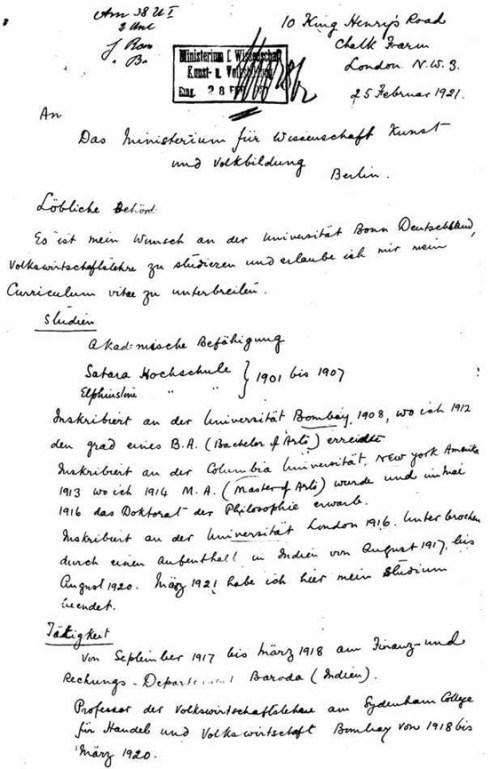
This idea made me visit the University Archives at Bonn on the 14th of January 2003 to find out more about Dr. Ambedkar’s studies at Bonn university. Within no time I found * Dr. Ambedkars  application for registration with the Prussian Ministry of Science, Fine Arts and Public Education, a  CV in German (!) and his  registration into the university ledger on 29 April 1921, which reads as follows:

Ambedkar studies at Heidelberg

Dr. Ambedkar studies at Heidelberg
Ambedkar in Germany 2

Dr. Ambedkar studies at Heidelberg

Ambedkar in Germany 3

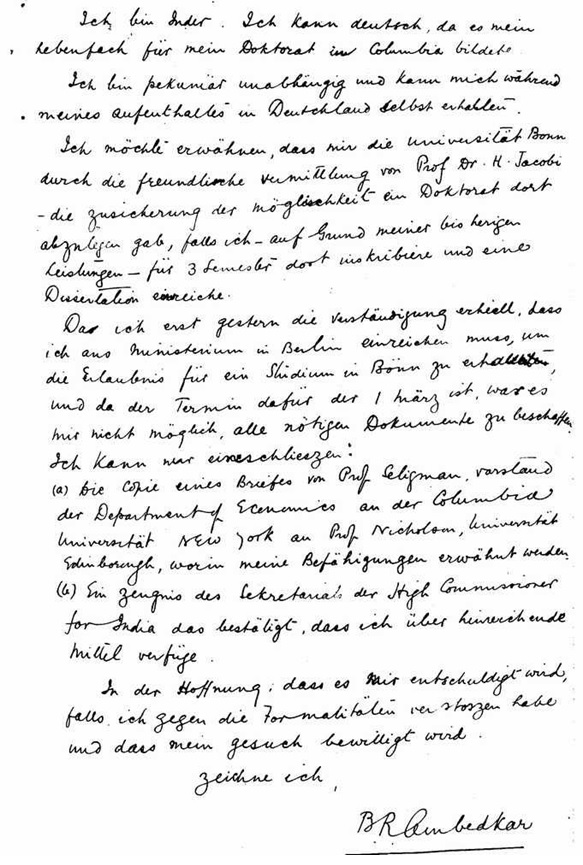
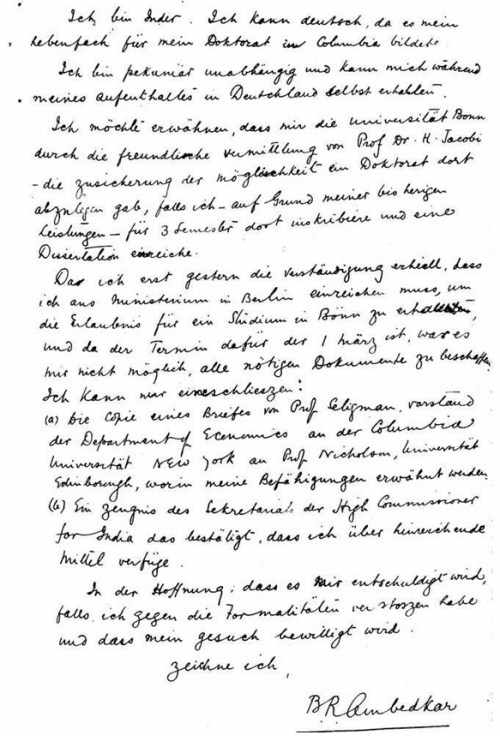
Handwritten curriculum vitae and letter of intent of Dr. Ambedkar in German
Ambedkar in Germany 4

Handwritten curriculum vitae and letter of intent of Dr. Ambedkar in German

Father’s profession: General; religion: Hindu; previous universities: Bombay, Columbia, London; number of semesters: 18; school leaving certificate: yes; subject: Economics; date of birth: 14.4.1891; place of birth: Mhow; home town: Bombay; district: Bombay. So he delightfully upgraded his father’s military rank. Noteworthy is also his religious affiliation- at the early stage of his life- certainly before he was contemplating on the question of conversion, he wrote Hindu under the heading of religion. Amazingly, Dr. Ambedkar registered for Economics and not for Indology.

In his handwritten CV he stated that he knew German well, because he had taken it as a minor at Columbia University: He continued: “I would like to mention that the University of Bonn through the kind help of Prof. Dr. H. Jacobi granted me to submit a Ph.D. thesis in case I show adequate performance and I am enrolled for three semesters there.” It is not clear in which subject he intended to submit his dissertation, or how he got in touch with Professor Hermann Jacobi (1850-1937), who was the leading German Indologist of his times.

Continue reading

9 Comments

Filed under Buddhism, Dalit-Bahujans, Dr B R Ambedkar, India

Free Download – “The Buddha and His Dhamma” book in Hindi, Marathi and English


Now, you have download The Buddha and His Dhamma book by Dr. Ambedkar in Hindi, Marathi and English from the following links.

BAHD

To download the book in English, click here.

To download the book in Hindi, click here.

To download the book in Marathi, click here.

To get other books by Dr. B. R. Ambedkar, click here.

Get More Marathi Books on Dr Ambedkar & Buddha (Free Download)

Related articles:

40 Comments

Filed under Buddha, Buddhism, Dalit-Bahujans, Dr B R Ambedkar, Equal Rights, India

16 January in Dalit History – Dr. Ambedkar: I am not asking for any special favour


16 January 1930: Periyar returned from Malaya to Tamil Nadu.

16 January 1931: Dr. Ambedkar commented on the Report of sub- committee no VII (defense) at the round table conference in London.

Dr. Ambedkar vehemtly fought for the rights of inclusion of all sections, including the depressed classed (presently called dalits) for recruitment in Indian Army and hence sought a substantiative amendment to clause (2) of paragraph 4 of the report. “No doubt”, he said, “I move the amendment primarily with a view to protecting the specific rights of the depressed classes, but in doing so I am not asking the Committee to confer any favour, I am asking the Committee to see us realize in practice the principle recognized in the Government of India Act, that no subject of His Majesty shall be debarred from entering any Public Service by reason of his caste, creed or colour. In doing so, therefore, I do not think I am asking for any special favour”.

For details do visit

http://www.ambedkar.org/ambcd/15B.%20Dr.%20Ambedkar%20at%20the%20Round%20Table%20Conferences.htm#a2

135265_449711565104957_150069038_o

16 January 1946: Riots between touchables and untouchables erupted (Hindu – Mahar riots).

Dr. Ambedkar believed that a candidate to be elected on reserved seat should be elected only on the votes of untouchables (separate electorates). However, as a consequce of Poona Pact (signed in 1932), the Congress party would field a candidate from any other untouchable against Dr. Ambedkar and they would have no problems with his candidature even if he was illereate or an absolute non-entity.  They would ask all (touchables) to give votes to their untouchable candidate. This was Kautilya – style strategy only to defeat Dr. Ambedkar! It was because of this that the deadly riots of Hindu vs Mahar erupted on 16 January 1946 in Nagpur against the Poona Pact.

The dalit movement in Nagpur came to be known as Mahar movement. Chambhars (leather workers) and Mangs (rope makers, also called Matangs) took part only as individuals. E.g. A gentleman named Behade was on the executive committee of the Scheduled Caste Federdarion. Ramratan Janorkar of Bhangi (sweeper) community dedicated his life to the Ambedkar movement and also became a Buddhist and later on Mayor of the Nagpur Municipal Corporation.

Continue reading

Leave a comment

Filed under Buddhism, Caste Discrimination, Dalit-Bahujans, Dr B R Ambedkar, Today in Dalit History, Today in History

15th January in Dalit History – B’day of Behan Mayawati


Behan Mayawati, a four-time Chief Minister of Uttar Pradesh, is chief of Bahujan Samaj Party which is, at present, main opposition party in the Assembly of Uttar Pradesh. Watch documentary and interview with Behan Mayawati

Also see rare pictures of Kanshi Ram Saheb and Mayawati.

Continue reading

4 Comments

Filed under BSP, Buddhism, Dalit-Bahujans, Documentary, Today in Dalit History, Today in History